Lot size looks like a universal trading unit. It isn’t. The contract specification and the distance to the stop determine what that number actually means in money.
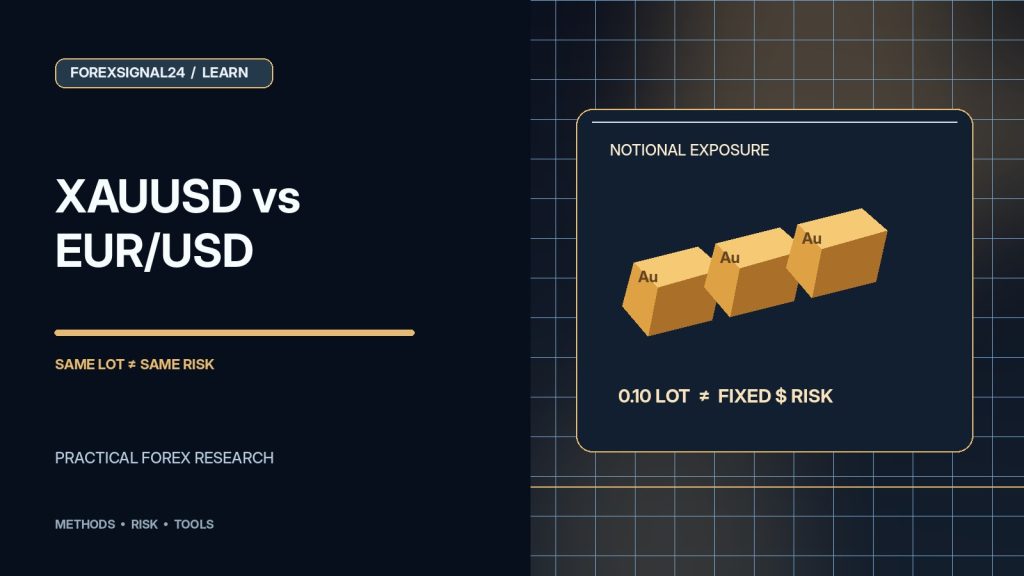
A trader who has used 0.10 lots in EUR/USD may be tempted to copy the same volume when switching to gold. Both orders display “0.10” in the trading terminal. But the underlying quantities are measured differently, and the relationship between price movement and cash exposure is not the same.
The comparison becomes clear when you stop thinking of a lot as a risk amount and calculate from the instrument specifications instead.
What 0.10 lot means in EUR/USD
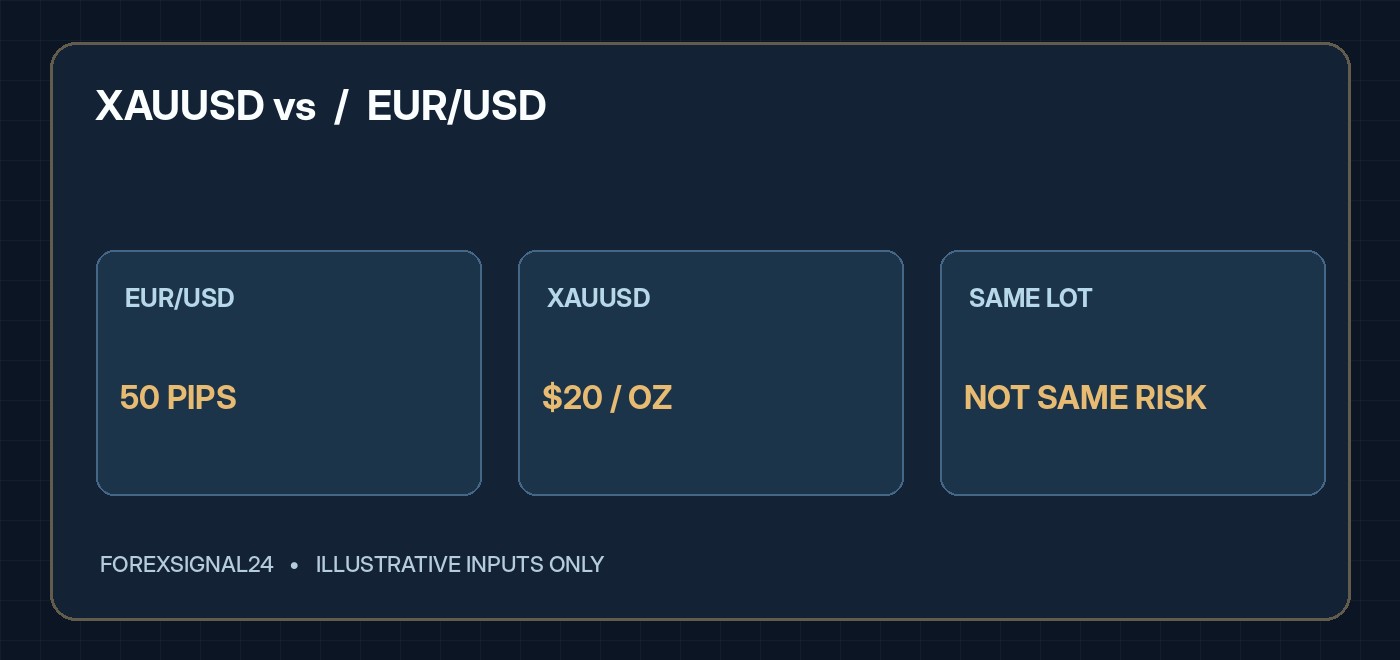
For an illustrative broker contract of 100,000 EUR per standard lot, an order of 0.10 lot represents 10,000 EUR of base currency. With a USD account and a conventional 0.0001 pip increment, one standard lot has a pip value of about $10; 0.10 lot is about $1 per pip.
If your stop is 50 pips from the entry, the price-distance risk estimate is $50 before commission, spread effects or slippage. This assumes the account currency and quoted pair arrangement in the example; the conversion may differ for a non-USD account or a cross pair.
What 0.10 lot can mean in XAUUSD
Now assume a hypothetical gold contract of 100 troy ounces per standard lot. A 0.10-lot order would represent 10 ounces of gold. A $5 per-ounce price movement would change the notional mark-to-market value by approximately $50 on that volume. A $20 movement would correspond to $200.
Those are price movements measured in dollars per ounce, not EUR/USD pips. A broker could use a different gold contract definition, tick size or volume increment. Never import a gold lot calculation from an online example without checking the actual XAUUSD symbol details.
| Illustrative setup | Contract assumption | Volume | Stop distance | Price-based risk |
|---|---|---|---|---|
| EUR/USD | 100,000 EUR / lot | 0.10 lot | 50 pips | $50 |
| XAUUSD | 100 oz / lot | 0.10 lot | $5/oz | $50 |
| XAUUSD | 100 oz / lot | 0.10 lot | $20/oz | $200 |
The first two rows happen to match in this particular example; the third does not. This is why “use the same lot size” is not a meaningful risk-control rule.
Calculate from the loss budget instead
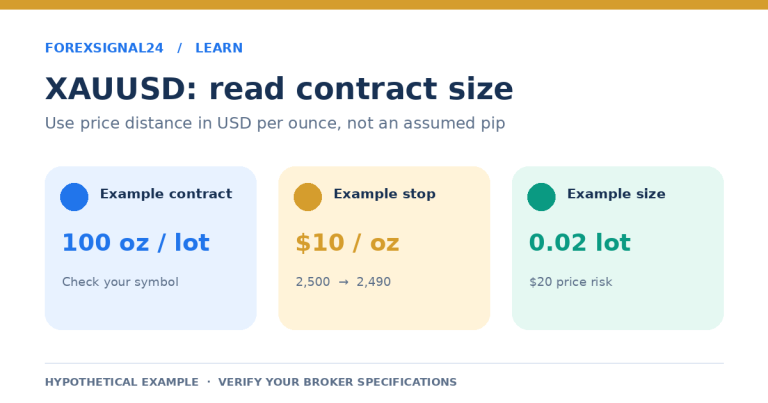
Suppose you choose a $40 illustrative loss budget and plan a $10-per-ounce stop on gold. Using a 100-ounce contract, the theoretical volume is $40 ÷ ($10 × 100) = 0.04 lot before adjustment for broker volume steps. If the contract were different, the answer would change.
The XAUUSD Lot Calculator helps make these inputs visible. Its companion XAUUSD contract-size guide explains the ounces-per-lot issue. For currency pairs, the Pip Value Calculator and the forex pips and lots guide explain the parallel calculation.
Margin and stop-loss risk answer different questions
Increasing leverage can lower the simplified margin required for a given position, but it does not make a 10-ounce gold position less sensitive to a one-dollar price move. Margin tells you something about the funds required to support the position; the planned stop distance multiplied by volume tells you about price-based exposure.
Review margin separately through the Margin Calculator. A stop is not a guaranteed fill price, so actual realised loss may differ from the original price-distance estimate. The news-trading risk guide demonstrates this difference with a hypothetical worse fill.
A short checklist when switching instruments
Open your trading platform’s symbol specifications and record the contract size, tick size, tick value, minimum lot, volume step, quote currency and account conversion. Use the exact entry and stop levels, not a guessed number of gold “pips.” Recalculate after changing instruments or stops, and check spreads and overnight financing if relevant.
FAQ: Is one gold pip always $1?
No. “Gold pip” is not applied consistently across brokers. Use the broker’s price increment, tick value and ounces-per-lot specification rather than a universal shortcut.
FAQ: Is a 0.01-lot gold position always safe for beginners?
No lot size is inherently safe. The exposure depends on the contract, stop distance, market conditions and what the trader can afford to lose.
FAQ: Does the same 1% risk mean the same lot size across pairs?
No. The same monetary loss budget can lead to different volumes because contract sizes, pip values, conversion rates and stops differ.
All contract sizes and price examples here are hypothetical teaching inputs. Check your own provider’s live instrument specifications.