XAUUSD is one of the most actively watched instruments in retail trading, but it is also one of the easiest to misunderstand. Gold can move quickly, spreads can change, brokers may use different contract specifications, and the informal language traders use for a “pip” in gold is not always consistent. A trader can therefore be right about market direction and still take far more risk than intended simply because the position size or symbol specification was misunderstood.
This guide brings the main pieces together in one place: what XAUUSD represents, how gold lot size and contract size work, why pip conventions can be misleading, how stop-loss distance connects to monetary risk, how leverage and margin differ from risk, what trading costs matter, and how to build a repeatable pre-trade workflow. It is designed as the central XAUUSD reference for ForexSignal24, with deeper guides linked where a topic deserves its own explanation.
Quick answer: XAUUSD usually means gold priced in US dollars, but the tradable symbol itself is broker-defined. Before sizing a trade, verify the symbol’s contract size, minimum volume, volume step, tick size, tick value, margin rules and swap conditions. Then calculate the position from your risk budget and stop distance rather than choosing a familiar lot number by habit.
What is XAUUSD?
XAU is the commonly used market code for gold and USD is the US dollar. In practical trading terms, XAUUSD expresses the price of gold in dollars. If a quote moves from 2,500 to 2,510, the quoted gold price has moved by USD 10 per ounce.
That simple price relationship does not mean every broker offers exactly the same trading contract. Retail platforms may provide XAUUSD as an OTC or CFD-style instrument with broker-defined specifications. One broker may use a particular contract size, minimum lot and volume step while another may use different values. The symbol name alone is therefore not enough to calculate risk.
Why XAUUSD behaves differently from a major currency pair
EUR/USD and XAUUSD can both appear in the same trading platform, but they are not interchangeable instruments. A currency pair is quoted as one currency against another. XAUUSD is a gold price quoted in dollars, and the economic forces behind gold can include real yields, interest-rate expectations, the US dollar, inflation expectations, geopolitical stress, central-bank demand and broader risk sentiment.
None of those relationships is mechanical. Gold can rise while the dollar is strong, fall during a period of uncertainty, or react differently from what a simple textbook relationship suggests. That is why a market thesis should be separated from position sizing. The trader’s view may be uncertain, but the amount of account risk can still be planned before the trade.
Start with the broker’s XAUUSD specification
Before calculating a gold trade, open the symbol specification in your trading platform. In MetaTrader, the Market Watch area provides access to contract specifications supplied by the broker. The exact labels can vary, but the most important fields normally include contract size, minimum volume, maximum volume, volume step, tick size, tick value, profit currency, margin information and swap conditions.
| Specification | Why it matters |
|---|---|
| Contract size | Defines how much underlying gold one full lot represents. |
| Minimum volume | The smallest lot size the broker allows. |
| Volume step | The increment used when increasing or decreasing lot size. |
| Tick size / price increment | The minimum quoted price movement defined for the symbol. |
| Tick value | Platform value associated with a tick under the broker’s specification. |
| Margin rules | Determines how much collateral is required to hold the position. |
| Swap / financing | Can affect positions held across the broker’s rollover period. |
The most important habit is simple: do not copy a lot-size formula from another broker and assume its contract specification matches yours. Verify first, calculate second.
XAUUSD contract size and lot size
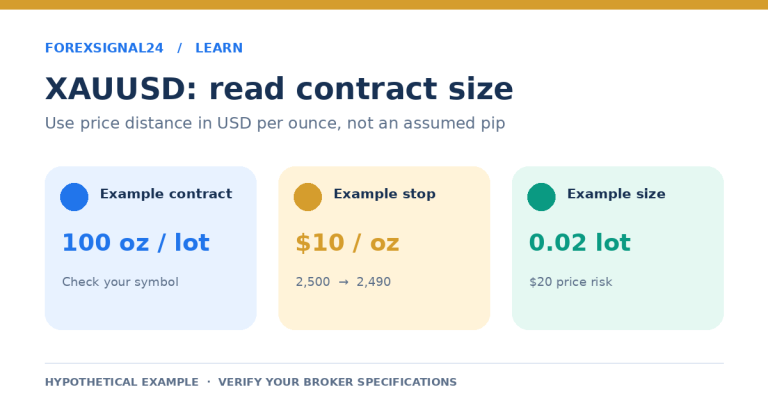
A lot is a trading-volume unit. The real economic exposure behind that lot depends on the contract size. As a hypothetical example, if a broker defines one XAUUSD lot as 100 troy ounces, then 1.00 lot represents 100 ounces, 0.10 lot represents 10 ounces and 0.01 lot represents one ounce.
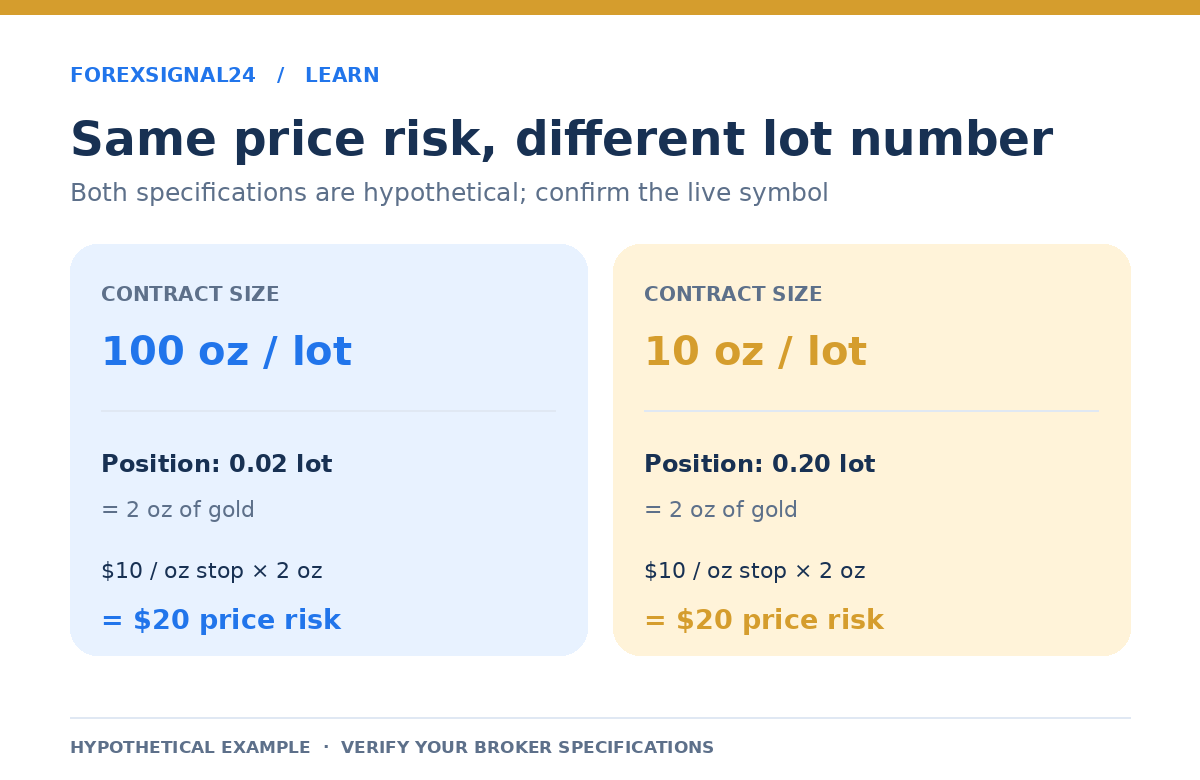
But that 100-ounce figure must not be treated as a universal rule. The broker’s own specification is the source that matters for the trade being considered. If another symbol used 10 ounces per lot, the same numerical lot size would represent one-tenth of the gold exposure in the 100-ounce example.
For a dedicated walkthrough, see XAUUSD Lot Size Explained: Contract Size, Stop Distance and Risk.
The safest way to think about a gold “pip”
Gold traders often use the word “pip” differently. Some call a USD 0.01 move one pip, some use USD 0.10, and others talk in points or ticks. The terminology may work inside one trading community, but it can create mistakes when copied across brokers or platforms.
For risk calculations, the cleanest approach is to use the actual price difference. If the planned entry is 2,500 and the stop is 2,490, the price distance is USD 10 per ounce. That value is unambiguous. It remains USD 10 per ounce regardless of whether someone informally calls the move 100 pips, 1,000 pips or something else.
The ForexSignal24 XAUUSD Lot Calculator is built around the actual entry and stop prices so the core position-sizing logic does not depend on a universal gold-pip convention.
How to calculate XAUUSD risk from the stop loss
A useful position-sizing process begins with the maximum amount of money the trader is prepared to lose if the stop is reached under the modelled assumptions. That amount can be expressed as a percentage of account balance or as a fixed monetary risk budget.
Suppose a hypothetical USD 10,000 account uses a 1% risk budget. The theoretical risk budget is USD 100. If the entry-to-stop distance is USD 25 per ounce and the broker specification says 100 ounces per lot, the modelled price risk for one full lot is USD 2,500 before spread, commission, slippage or gaps.
The simplified calculation is:
Raw lots = monetary risk budget ÷ (price distance × ounces per lot)
Using the hypothetical values:
USD 100 ÷ (USD 25 × 100 ounces) = 0.04 lot
That 0.04-lot figure is only an estimate under the assumptions entered. The broker’s volume step may require rounding, a non-USD account may require currency conversion, and real execution costs can make the final loss larger than the simple stop-distance calculation.
Why the same lot size can carry very different risk
Many traders become attached to a familiar number such as 0.01, 0.05 or 0.10 lot. The problem is that a fixed lot size does not produce fixed risk. A 0.10-lot trade with a USD 5 stop is structurally different from the same 0.10-lot trade with a USD 30 stop.
If the goal is to keep the monetary risk broadly consistent, a wider stop generally requires a smaller position and a tighter stop mathematically allows a larger position. The stop should still be selected for a market-structure reason; shrinking the stop purely to force a bigger lot size reverses the logic of risk management.
Leverage, margin and risk are three different things
Leverage determines how much market exposure can be controlled relative to the margin required by the broker. Margin is collateral reserved to support the position. Neither number tells you how much money will be lost if the market reaches the stop.
This distinction matters on gold because an account may have enough available margin to open a position that is still far too large for the trader’s risk plan. The question “How much can I open?” is therefore different from “How much should I trade if I only want to risk this amount?”
Position sizing should answer the second question. Margin should then be checked as an additional account-survival constraint, not used as the position-size target.
Spread, commission and slippage can increase the real cost
The stop-distance formula measures price movement, not every trading cost. XAUUSD is quoted with a bid and ask, so the spread matters immediately. Depending on the account type, the broker may also charge a separate commission. During fast markets, execution can differ from the requested price, which creates slippage.
A practical risk estimate therefore needs a buffer. The exact buffer depends on the broker, account type, trading session and market conditions. It is especially important around major economic releases or sudden geopolitical headlines, when spreads can widen and price can move through a stop level before the order is filled.
Overnight swap and financing
If a gold position is held beyond the broker’s rollover period, an overnight financing or swap adjustment may apply. The calculation method, long and short rates, charging day and any multi-day rollover convention can vary by broker and legal entity.
That means a short intraday position and a multi-day swing trade can have very different cost structures even when the entry price and lot size are identical. Traders who routinely hold positions overnight should treat financing as part of the planned trade cost rather than as an afterthought.
When XAUUSD can become more volatile
Gold liquidity and volatility change through the trading day. Activity often becomes more important when European and US markets overlap and around major US economic releases, but there is no universal “best hour” that guarantees a better trade. A busy session can improve liquidity while also increasing the speed and size of price movement.
Events that can produce larger-than-normal reactions include central-bank decisions, inflation data, labour-market releases, major changes in bond yields, unexpected geopolitical developments and large shifts in the US dollar. The safer conclusion is not “trade every news release,” but “know whether a scheduled catalyst can change the assumptions behind the position.”
A practical XAUUSD pre-trade workflow
- Define the trade idea first. Choose the entry area, invalidation point and stop based on the trading setup rather than a desired lot size.
- Check the broker specification. Confirm contract size, volume step, minimum lot, margin rules and relevant costs.
- Set a risk budget. Decide the amount or percentage of the account that the model is allowed to lose at the stop.
- Calculate the raw lot size. Use actual entry and stop prices together with the verified contract size.
- Round down when necessary. Respect the broker’s volume step instead of rounding up and unintentionally increasing risk.
- Add cost awareness. Consider spread, commission, possible financing and the possibility of slippage or gaps.
- Check margin after sizing. Confirm that the planned position does not create an unhealthy margin situation.
- Review upcoming catalysts. Know whether a major data release or policy event is near the planned trade.
Calculate the lot after defining the trade
A disciplined workflow is usually setup → stop → risk budget → lot size, not lot size → stop. Enter your own assumptions into the ForexSignal24 tool and then verify the result against your broker’s current symbol specification.
Worked example: from account risk to gold position size
Assume a trader has a USD 5,000 account and wants the modelled price risk to be 0.5% of the account. That produces a risk budget of USD 25. The planned long trade has a hypothetical entry at 2,500 and stop at 2,490, so the distance is USD 10 per ounce. The symbol specification is assumed to be 100 ounces per lot.
| Input | Hypothetical value |
|---|---|
| Account balance | USD 5,000 |
| Risk budget | 0.5% = USD 25 |
| Entry | 2,500 |
| Stop | 2,490 |
| Price distance | USD 10 per ounce |
| Contract size | 100 ounces per lot |
| Price risk per 1.00 lot | USD 1,000 |
| Raw position size | 0.025 lot |
If the broker’s volume step is 0.01 lot, 0.025 cannot be entered exactly. Rounding down to 0.02 lot would keep the modelled price risk below the USD 25 budget, while rounding up to 0.03 lot would exceed it before trading costs. This small detail is one reason volume step matters.
What can go wrong even when the calculation is correct?
Position sizing is a planning tool, not a guarantee. A stop order can be filled beyond the requested level during fast movement or a price gap. Spreads can widen. Conversion rates can change for accounts denominated in another currency. Brokers can also modify trading conditions, especially around exceptional market events.
The correct mindset is therefore to use the calculation as a controlled estimate. A trader cannot control the next tick in gold, but can control whether the position was sized from verified inputs or chosen by guesswork.
Common XAUUSD mistakes
Assuming 0.01 lot has the same meaning everywhere
It only has a clear economic meaning after the contract size is known. The same numerical volume can represent different underlying exposure on different symbols.
Using a forex pip formula without checking the gold convention
Gold price increments and informal pip language can differ. Using the direct USD-per-ounce price difference is normally clearer for risk calculations.
Choosing lot size before choosing the stop
This makes the risk budget adapt to the preferred lot number rather than the trade structure. A more disciplined sequence is to define invalidation first, then calculate size.
Confusing margin with maximum loss
Margin is not a stop-loss guarantee. A small margin requirement can still support a position capable of producing a much larger loss.
Ignoring transaction costs
Spread, commission, swap and slippage can all move the final result away from the simple theoretical calculation.
How ForexSignal24’s XAUUSD tools fit together
The central calculator is designed for practical scenario testing. The supporting guides explain the concepts behind the numbers so the tool is not a black box.
- XAUUSD Lot Calculator — estimate lot size from balance, risk, entry, stop and editable symbol specifications.
- XAUUSD Lot Calculator Guide — a detailed walkthrough of the calculator and its inputs.
- XAUUSD Lot Size Explained — contract size, ounces, stop distance and risk.
- Forex Pips, Lots and Pip Value — the currency-pair foundation for comparing units and lot concepts.
- Position Size Calculator Guide — position sizing workflow for forex pairs.
Additional XAUUSD articles should earn their place in this cluster by answering a specific reader question that the pillar cannot cover deeply without becoming bloated. That is the structure we will use for future expansion.
Frequently asked questions
What does XAUUSD mean?
XAU represents gold and USD represents the US dollar. XAUUSD therefore expresses the quoted price of gold in dollars, although the broker’s tradable contract remains broker-specific.
How much is 0.01 lot of XAUUSD?
There is no safe universal answer without the symbol specification. If one lot equals 100 ounces, 0.01 lot represents one ounce. If the contract size is different, the underlying exposure changes accordingly.
How do I calculate lot size for XAUUSD?
Start with a monetary risk budget, measure the actual entry-to-stop price distance, multiply that distance by the contract size to estimate the risk of one lot, then divide the risk budget by that value. Adjust for account-currency conversion and the broker’s volume step where needed.
Is a gold pip always USD 0.01?
No. Traders and platforms can use different conventions. For position sizing, using the actual quoted price difference is clearer than assuming a universal gold-pip definition.
Does higher leverage reduce XAUUSD risk?
No. Higher leverage may reduce the margin required to hold a position, but it does not automatically reduce the price risk between the entry and stop. A larger position can still lose more money even when the margin requirement looks small.
Can the XAUUSD calculator guarantee my maximum loss?
No. It estimates risk from the inputs provided. Spread, commission, slippage, gaps, financing, conversion changes and broker execution conditions can make the realised result different.
Sources and further reading
- MetaTrader 5 Help: Market Watch and contract specifications.
- CME Group: Proper Position Size.
- CFTC: leveraged OTC trading risk guidance.
Educational content only. Gold, forex and CFD trading involve substantial risk. Examples in this guide are hypothetical and are not live prices, trading signals, investment advice or a guarantee of future results. Always verify the current XAUUSD specification and trading conditions for your broker, account and legal entity.