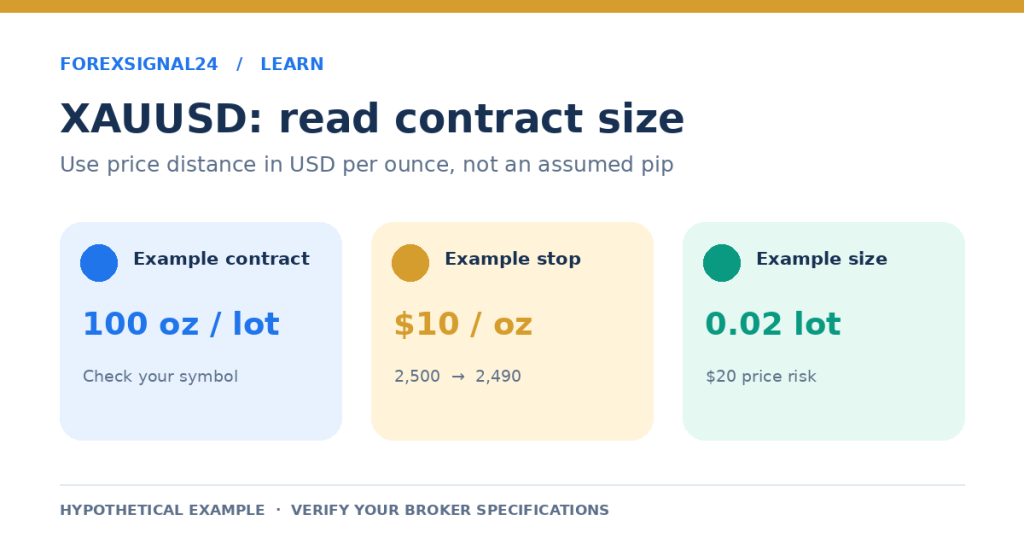
A trader can type “0.01 lot” for XAUUSD and still be unsure how many ounces the order represents. The answer is in that broker symbol’s contract size. This guide uses the lot and price unit basics and the stop based position size method to calculate a hypothetical gold position without assuming a universal gold pip. No quoted price below is current market data.
Key takeaways
- Gold lot volume must be multiplied by the symbol’s ounces per lot; the number is defined in the broker’s contract specification.
- With an illustrative 100 ounce contract, a $10 per ounce price move and 0.02 lot, the modelled price change is $20 before costs.
- A platform point, tick and “gold pip” can mean different increments. A direct USD per ounce price difference avoids that naming problem.
Find what one lot means on your symbol
XAUUSD usually expresses a gold price in US dollars per troy ounce, but the trading instrument and its contract can differ by broker or account. In MetaTrader, open Market Watch, choose the symbol and open Specification. Read Contract size, Tick size, Tick value, Minimum volume, Volume step, Profit currency and any applicable swap terms. MetaTrader documents these as broker supplied symbol properties. An “XAUUSD” label by itself does not establish a 100 ounce contract.
For the first worked example, assume that the contract size is 100 troy ounces per lot. This is an input to the arithmetic, not a statement about every broker. Then 1.00 lot represents 100 ounces, 0.10 lot represents 10 ounces and 0.01 lot represents one ounce. If your symbol says 10 ounces per lot instead, every one of those ounce amounts is ten times smaller.
Use the price difference in dollars per ounce
Imagine a long position entered at a hypothetical $2,500 per ounce and a stop at $2,490. The price distance is $10 per ounce. On a USD account, the simple price risk formula is lots × ounces per lot × USD price distance per ounce. With 0.02 lot and a 100 ounce contract, the position is two ounces and the price movement to the stop is 2 × $10 = $20 before any trading costs.
| Hypothetical symbol | Volume | Gold exposure | Price loss at a $10/oz move |
|---|---|---|---|
| 100 oz per lot | 0.02 lot | 2 oz | $20 |
| 10 oz per lot | 0.20 lot | 2 oz | $20 |
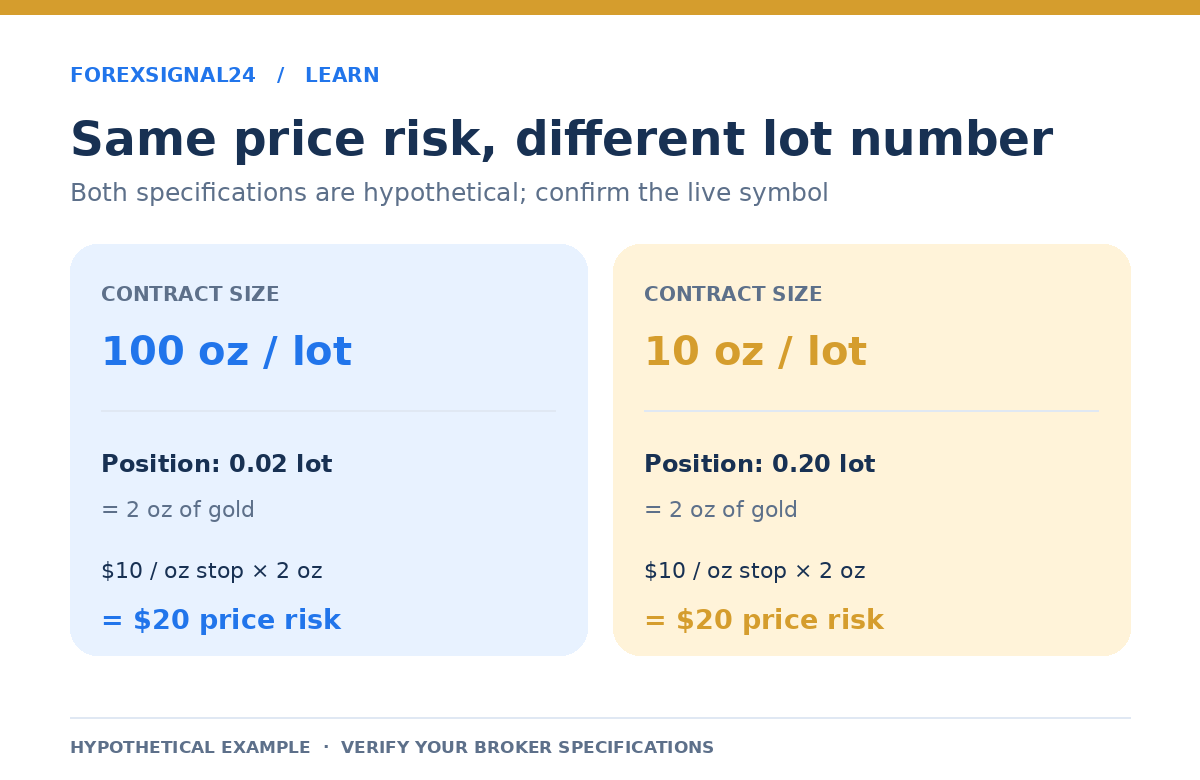
The right side of the comparison is a second hypothetical contract. It is not a claim that a particular named broker offers a 10 ounce XAUUSD lot. The minimum and step for both examples would still have to permit those volumes.
Work backward from a money budget
Suppose a trader’s hypothetical price risk budget is $20 and the chosen entry to stop distance is $10 per ounce. First divide $20 by $10 per ounce: the maximum modelled exposure is two ounces. With 100 ounces per lot, two ounces ÷ 100 ounces per lot = 0.02 lot. With 10 ounces per lot, two ounces ÷ 10 ounces per lot = 0.20 lot. This is the same logic as the EUR/USD position size example, with a different unit.
If your account is not in USD, convert the USD result into the account currency at an appropriate rate. If the broker’s minimum volume or step will not allow a position at or below the chosen price risk budget, reducing the numerical stop just to fit the order is not a sound arithmetic fix; the position may simply be too large for that budget.
Why “gold pip” can confuse the calculation
Some traders call a $0.01, $0.10 or even $1.00 move a “pip” in gold. Platform points and ticks can also differ from those informal usages. Calling the $2,500 to $2,490 distance “1,000 pips” under one convention and “100 pips” under another does not change the $10 per ounce move. The XAUUSD Lot Calculator asks for actual entry and stop prices and an editable contract size, so the primary calculation does not depend on a universal gold pip definition.
Spread, financing, leverage and execution
XAUUSD quotes have a bid and an ask. The spread, any commission and possible overnight charges can change the outcome beyond the simple $20 price distance. MetaTrader’s symbol specification can show the swap calculation type, but actual charges and timing must be verified with the broker. Different execution prices, slippage and gaps can make a stop order close at a worse level. A margin requirement is collateral, not a guaranteed loss cap.
Check current conditions for your legal entity and account before trading. The CFTC’s forex advisory describes how leverage magnifies losses in OTC trading; gold CFDs may be subject to different rules by jurisdiction and broker. No diagram here forecasts a gold move or recommends an order.
Frequently asked questions
Is 0.01 XAUUSD lot always one ounce?
No. That happens only if the symbol contract is 100 ounces per lot. For a 10 ounce contract, 0.01 lot is 0.1 ounce. Always multiply volume by the contract size displayed for your symbol.
What does a $1 gold move do to a position?
Multiply the $1 per ounce move by the ounces represented. In the hypothetical 100 ounce contract, 0.01 lot is one ounce, so a $1 move changes the modelled price P&L by $1 before costs. Direction determines whether it is a gain or loss.
Continue the series
Review how lot sizes and pip values work in currency pairs and how to calculate volume from a stop and risk budget. The XAUUSD Lot Calculator lets you replace every example input with your symbol’s specifications.
Sources and further reading
- MetaTrader 5: symbol specification in Market Watch (checked September 24, 2026).
- CME Group: Proper Position Size (checked September 24, 2026).
- CFTC: Eight Things You Should Know Before Trading Forex (checked September 24, 2026).