Gold trading can look deceptively simple on a chart. You identify a setup, choose an entry, place a stop loss, and decide where to take profit. Yet one of the most important decisions comes after that: how large should the position actually be?
That is where many traders get into trouble. A position that is too large can expose an account to far more risk than intended, while a position that is too small may not reflect the trading plan properly. With XAUUSD, the calculation can become even more confusing because contract specifications are not always identical across brokers.
The XAUUSD Lot Calculator from ForexSignal24 is designed to make that process easier. Instead of guessing whether a trade should use 0.01, 0.05, 0.10 lots, or something else entirely, the calculator helps estimate position size based on the actual structure of the trade: account balance, risk percentage, entry price, stop-loss distance, contract size, and broker specifications. In other words, lot size becomes part of the trading plan rather than an arbitrary number.
Why XAUUSD Lot Size Should Not Be Based on Guesswork
Many traders develop a habit of using the same lot size on almost every gold trade. For example, someone may routinely trade 0.10 lots regardless of whether the stop loss is USD 5 away or USD 30 away. The lot size may be the same, but the risk clearly is not.
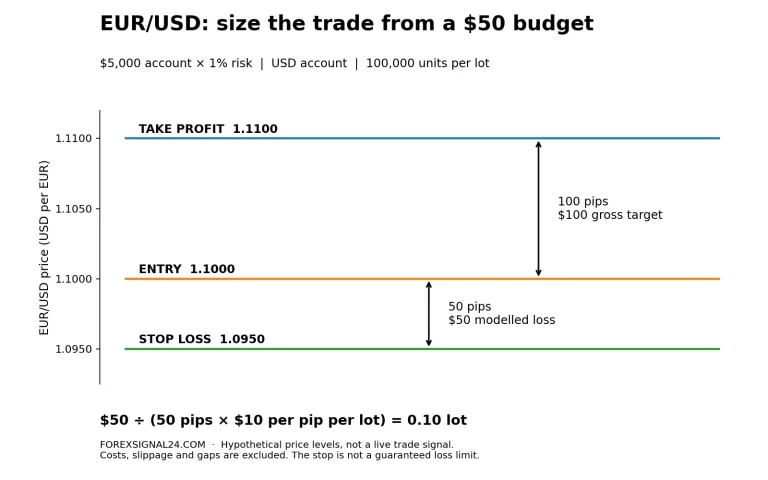
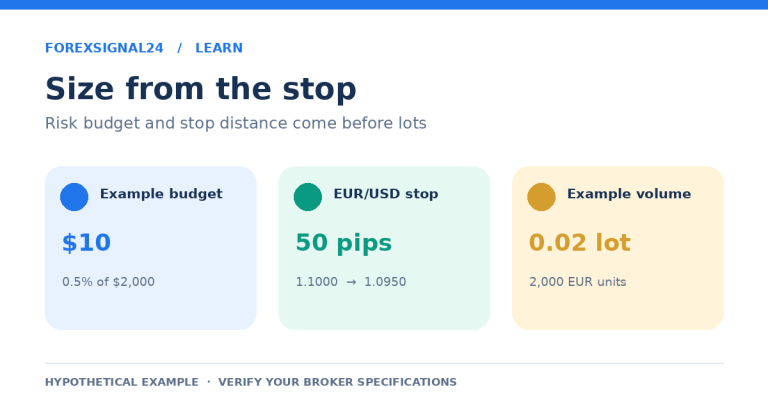
A wider stop means the market can move further against the position before the trade is closed. If the trader wants to keep the amount of money at risk relatively consistent, the position size needs to adjust accordingly. That is the basic idea behind position sizing. Instead of simply asking, “How many lots should I trade?”, a more useful question is: “Given my account balance, risk limit, and stop-loss distance, what position size makes sense?”
That is exactly the question the ForexSignal24 XAUUSD Lot Calculator is built to help answer.
What Is the ForexSignal24 XAUUSD Lot Calculator?
The XAUUSD Lot Calculator is a browser-based position sizing tool designed specifically for gold trades. It does not predict where gold will move next, generate buy or sell signals, or place trades on behalf of the user. Its purpose is much simpler: it takes the parameters entered by the trader and estimates a position size based on the selected level of risk.
The calculator allows users to enter key information such as account balance, risk percentage, Buy or Sell direction, entry price, stop loss, take profit, XAUUSD contract size, currency conversion, leverage, volume step, minimum lot, and maximum lot. Once those values are entered, the tool processes the setup and provides an estimated position size along with a clearer breakdown of how the result is calculated.
How the XAUUSD Lot Calculator Works
The logic behind the calculator is straightforward. First, it determines how much money the trader is willing to risk. Imagine a hypothetical account with a USD 10,000 balance and a 1% risk budget. The amount being used as the theoretical risk limit would be:
USD 10,000 × 1% = USD 100
The calculator then looks at the distance between the entry price and the stop loss. Suppose the planned entry is 3,500 and the stop loss is 3,475. The distance between the two levels is USD 25. Now assume the broker uses a contract size of 100 ounces per lot. A USD 25 move on one full lot would represent:
USD 25 × 100 ounces = USD 2,500 per lot
If the trader wants the theoretical risk to remain around USD 100, the calculation becomes USD 100 ÷ USD 2,500 = 0.04 lot. Based on those assumptions, the estimated position size would be approximately 0.04 lot.
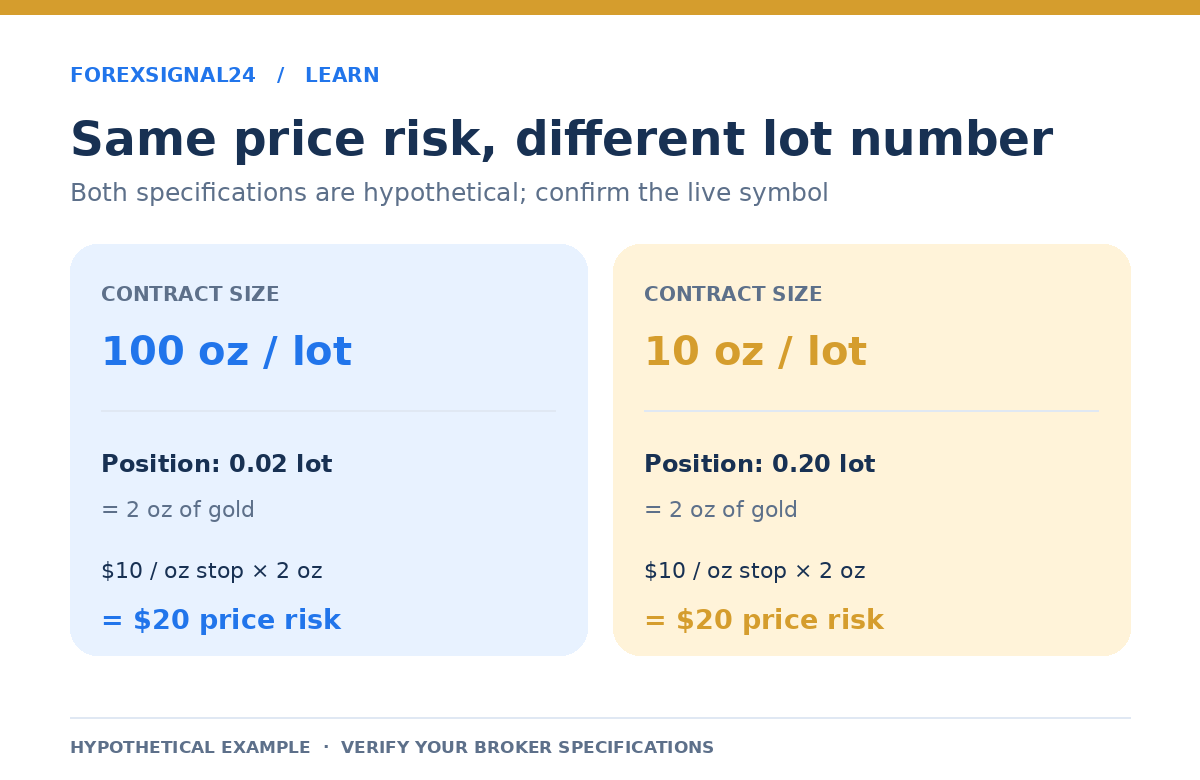
The final result may still need to reflect minimum lot size, maximum lot size, volume step, currency conversion, and the exact symbol specifications used by the broker, but the example shows the core relationship clearly.
How to Use the XAUUSD Lot Calculator
Using the calculator is relatively simple. Start by entering the account balance you want to use as the basis of the calculation, then set the percentage of that balance you are prepared to use as the risk budget. For example, if the balance is USD 10,000 and the selected risk budget is 1%, the calculator will use USD 100 as the theoretical risk amount. The tool does not decide what percentage a trader should risk; it simply converts the percentage chosen by the user into a monetary value.
Next, choose whether the planned trade is a Buy or Sell, then enter the entry price and stop-loss level. These two prices are particularly important because the calculator works from the actual price distance between them rather than relying on a universal definition of a “gold pip.” A take-profit level can also be entered to provide additional context around the potential reward of the setup.
For instance, if the entry is 3,500, the stop loss is 3,475, and the take profit is 3,550, the trade has a USD 25 distance to the stop and a USD 50 distance to the target. On a purely mathematical basis, that represents a price risk-to-reward relationship of roughly 1:2, before trading costs such as spread, commission, and slippage are taken into account.
Contract Size Matters More Than Many Traders Realize
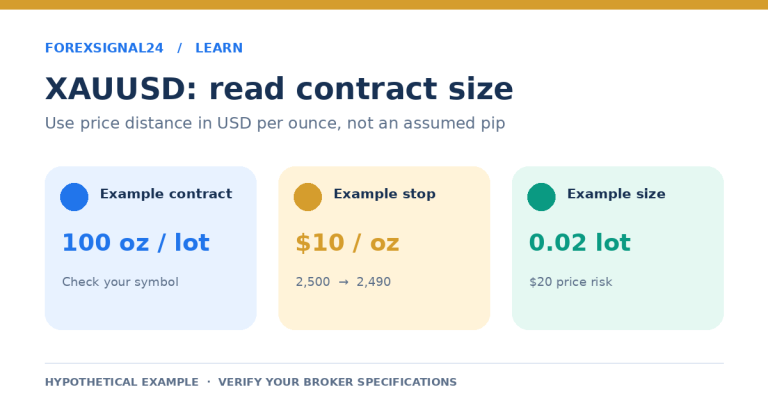
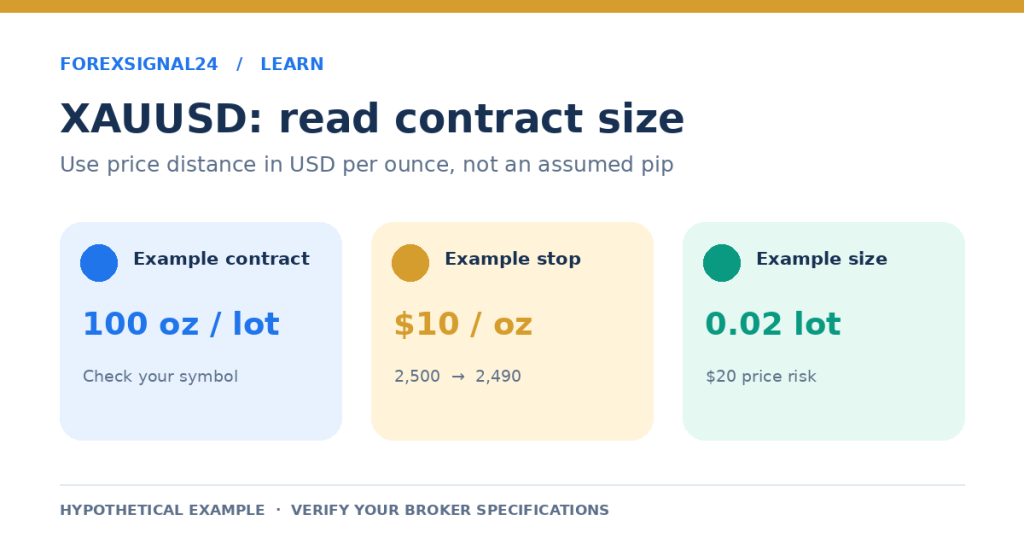
One of the most important details in any XAUUSD calculation is the broker’s contract size. Traders should not automatically assume that 1 lot of XAUUSD always equals 100 ounces. While 100 ounces per lot is a common specification and may appear as a default example, the actual value should always be checked with the broker.
Different brokers, symbols, account types, or trading conditions may use different specifications. Before relying on the calculated position size, it is worth checking the symbol specification on the trading platform for values such as Contract Size, Minimum Volume, Maximum Volume, Volume Step, Tick Size, and Tick Value.
If the broker uses a different contract size, the estimated lot size can change significantly. That is why the ForexSignal24 calculator allows the contract-size field to be adjusted instead of treating it as a fixed universal number. For a deeper explanation, see our guide to XAUUSD lot size, contract size, stop distance and risk.
Why a Wider Stop Loss Usually Means a Smaller Position
One of the easiest ways to understand position sizing is to keep the risk budget unchanged and adjust the stop-loss distance. Imagine that the trader still wants to risk around USD 100. In one setup, the stop loss is USD 10 away from the entry. In another, it is USD 25 away. If everything else remains equal, the second trade should normally produce a smaller position size because each lot is exposed to a larger potential price movement.
The relationship is simple: a wider stop generally requires a smaller position, while a tighter stop can mathematically allow a larger position. This is one reason why using exactly the same lot size on every gold trade can create inconsistent risk. Position size should reflect the structure of the individual setup rather than habit alone.
Leverage and Risk Are Not the Same Thing
The calculator also includes leverage as one of its inputs, but leverage should not be confused with the amount of money being risked at the stop loss. Leverage primarily affects the amount of margin required to hold a position. A higher leverage ratio may reduce the margin needed to open a trade, but it does not automatically make that trade safer.
An account may technically have enough margin to open a large XAUUSD position while that position is still far too large for the trader’s risk plan. There is therefore an important difference between asking “How large a trade can my account open?” and “How large should this trade be based on my risk limit?” The second question is far more relevant to disciplined position sizing.
Why This Tool Is Useful for Gold Traders
One of the strongest features of the ForexSignal24 XAUUSD Lot Calculator is the visibility of its assumptions. Users can adjust the account balance, risk percentage, entry price, stop loss, take profit, contract size, leverage, currency conversion, and broker volume limits instead of relying on a hidden formula.
That makes the calculator useful not only for checking a single position but also for running quick scenarios. A trader can reduce the risk percentage, widen the stop loss, change the contract size, compare different setups, or adjust leverage and volume step to see how each variable affects the result. Used this way, the calculator becomes more than a simple lot-size tool; it becomes a practical way to understand the relationship between risk, stop-loss distance, contract size, and position size.
Manual Inputs, Not Live Market Prices
The ForexSignal24 calculator works from values entered by the user. It is not automatically connected to a live XAUUSD price feed, and it does not send orders to a broker. That keeps the purpose of the tool clear: the trader defines the setup, the calculator processes the numbers, and the user decides whether the resulting position size fits the broader trading plan.
Before entering a real position, traders should still confirm the latest market price, spread, contract specification, and trading conditions directly with their broker.
Position Sizing Is Still an Estimate
Even a carefully calculated position size cannot guarantee that the final trading result will exactly match the initial risk budget. Real market conditions include factors such as spread, commission, swap, slippage, price gaps, execution conditions, and currency conversion. During fast-moving markets, a stop-loss order may also be filled at a different price from the level originally entered.
For that reason, the calculator should be treated as a risk-planning tool, not as a guarantee of maximum loss. Its real value is in creating a more structured estimate before the trade is placed.
A Better Workflow Before Trading XAUUSD
A practical way to use the calculator is to build the trade first and calculate the lot size last. Suppose the setup is already defined with an entry at 3,500, a stop loss at 3,475, and a take profit at 3,550. The trader then decides how much of the account is appropriate to risk, enters those values into the calculator, and receives an estimated lot size.
The final step is to compare that result with the broker’s contract specification and volume limits before making any trading decision. With this workflow, position size becomes the result of the trading plan rather than the starting point. That small shift can make risk management much more consistent.
From “How Many Lots?” to a Better Question
A common question among gold traders is: “I have this much money in my account. How many lots should I use?” The problem is that account balance alone does not provide enough information. Position size only becomes meaningful when it is considered alongside risk percentage, entry price, stop-loss distance, contract size, and broker specifications.
Two traders with exactly the same USD 10,000 balance may end up with very different position sizes because their stop-loss distances and chosen risk budgets are different. That is the real value of the ForexSignal24 XAUUSD Lot Calculator: it connects four important elements—Account Balance → Risk Budget → Stop-Loss Distance → Position Size.
The result is not a trading signal and does not tell the trader whether a setup will succeed. What it provides is something more practical: a position-size estimate that can be checked, adjusted, and compared before a trade is opened. For traders who regularly trade gold, that simple habit can make risk management far more disciplined than choosing lot size by instinct.
Try the XAUUSD Lot Calculator
Already have a gold setup in mind? Enter your balance, risk budget, entry price, stop loss, and broker contract specification into the ForexSignal24 XAUUSD Lot Calculator, then see how the estimated position size changes as you adjust the trade.
Try widening the stop loss while keeping the same risk budget, then reduce the risk percentage and calculate again. The relationship between risk and position size becomes much easier to understand once you can see how the numbers react. Instead of guessing the lot size, start with the risk.
For educational purposes only. Forex, gold, and CFD trading involve substantial risk. Calculator results are estimates based on user inputs and should not be interpreted as trading signals, investment advice, or guarantees of future results.