The stop-loss number on your chart is not always the amount you will lose. Around major economic releases, order execution and transaction costs can matter as much as the direction of the trade.
A trader checks a position-sizing calculator before a central-bank announcement. The proposed EUR/USD trade risks 30 pips, and the lot size appears comfortably within budget. Seconds after the release, however, the spread widens and the stop executes several pips beyond the requested level. The original calculation was not necessarily wrong. It was incomplete for the conditions.
The right question before high-impact news is not simply “How many lots can I open?” It is “Which assumptions could fail, and how much would that change my estimated loss?”
Why news makes a stop-based estimate less certain
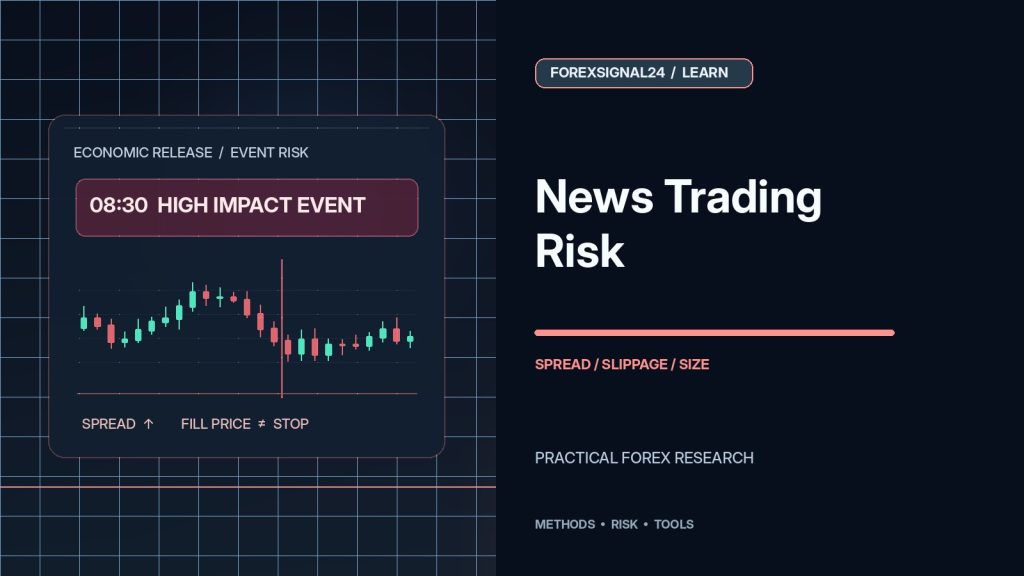
Three mechanisms need separate consideration. Spread is the difference between executable bid and ask quotes. Slippage is a fill at a different price from the requested order level. Liquidity describes how much can actually be transacted at available prices. During fast repricing, these conditions may change abruptly.
A protective stop normally becomes an order when its trigger is reached. It is not a universal guarantee of execution at the stop price. Some providers offer guaranteed stops under specific terms, often with separate fees or restrictions; do not assume your account has one.
The CFTC’s retail forex advisory explains how leverage can magnify risk and why trading arrangements deserve careful scrutiny. This is a reason to read your provider’s execution and order policies, not a reason to believe every news event behaves identically.
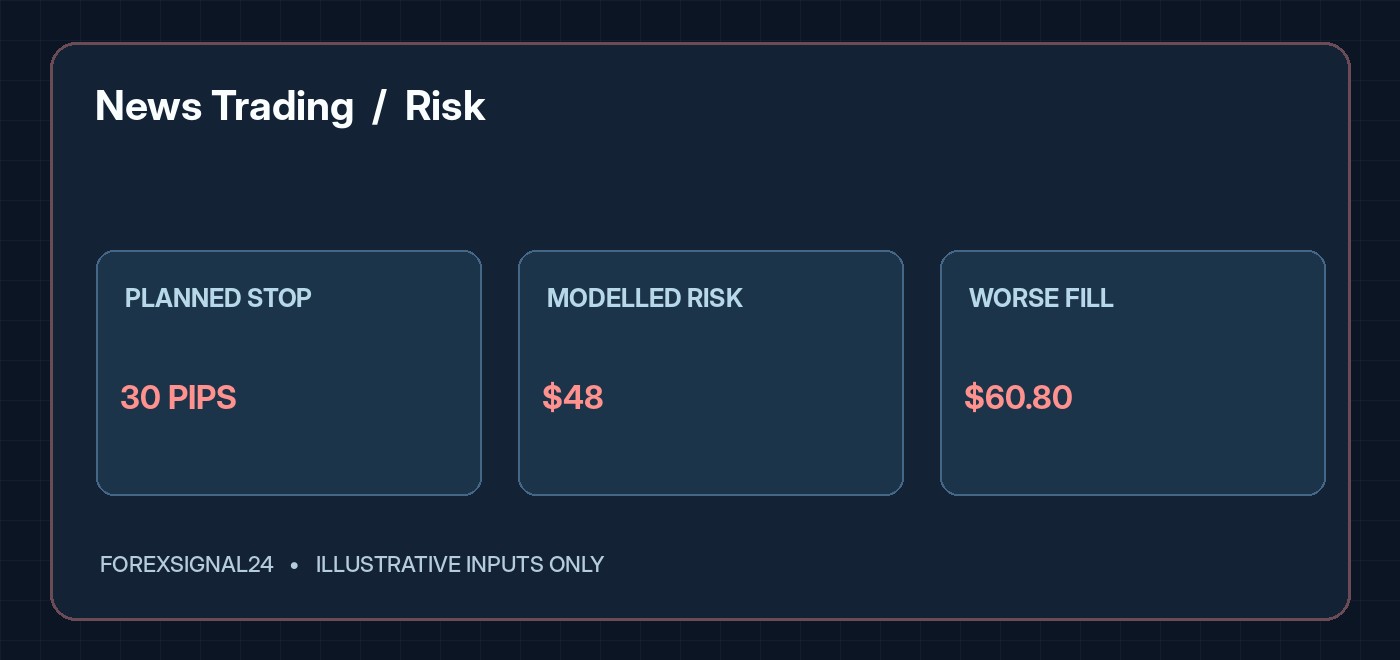
A hypothetical news-trade cost calculation
Suppose a USD account has a $5,000 balance and a chosen risk budget of $50. The plan uses EUR/USD with a 30-pip stop. For illustration, assume a USD $10 pip value per standard lot.
| Item | Simplified estimate |
|---|---|
| Planned stop distance | 30 pips |
| Raw theoretical lot size | 0.1667 lot |
| Rounded down to 0.01 step | 0.16 lot |
| Price-distance risk at the stop | $48.00 |
| Additional adverse slippage, hypothetical | 8 pips |
| Extra adverse price movement cost | $12.80 |
| Total modelled price-movement loss | $60.80 |
The last line excludes separately charged commission and does not attempt to predict how far a price could move. It simply illustrates why an 8-pip worse fill would matter. With a different account currency or symbol specification, the pip-value calculation would change.
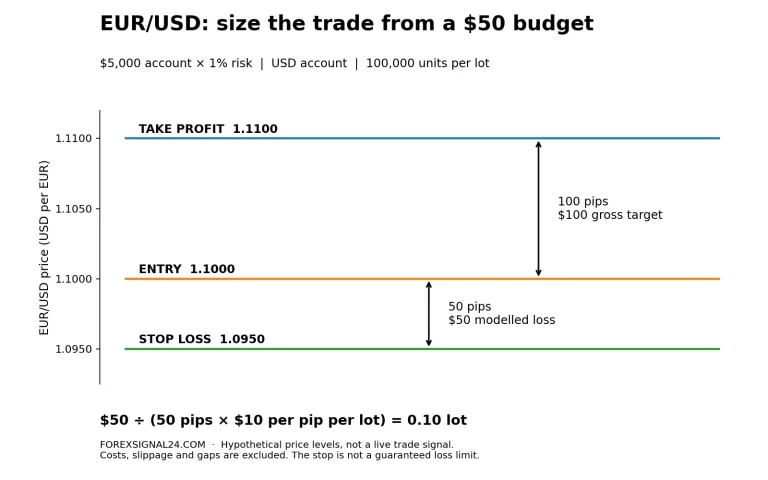
Use the Position Size Calculator for the planned volume and the Spread & Commission Calculator to understand explicit costs. For the underlying lot-sizing method, see the EUR/USD stop-loss example.
Check timing as carefully as direction
Record the precise release time, its timezone, and whether your trading session crosses a daylight-saving change. A chart’s platform time may differ from the calendar’s display time. The Forex Market Sessions page can help with session context, while the Market Data & Calendar page provides event-oriented research tools.
A release can affect related pairs in different ways. There is no universal safe number of minutes before or after a release: spreads and depth depend on the instrument, broker, event and market conditions.
A practical high-impact-event checklist
Before a trade, document whether the announcement is part of your tested strategy or an avoidable exposure. Verify the exact instrument contract, bid/ask behaviour, expected execution method, and whether the broker applies event-specific restrictions. Consider how a worse fill would affect your loss budget, including positions already open. Avoid using the minimum required margin as a proxy for acceptable risk.
After the event, save the actual entry price, stop trigger, fill price, spread and commission. A simple journal comparing intended and realised loss gives you more useful evidence than a screenshot showing only whether the trade won or lost.
When staying out is the valid result
There is no obligation to trade a major release. If you cannot estimate exposure within a reasonable range, if a stop would need to be arbitrary, or if transaction costs overwhelm the potential reward, not placing the trade is a defensible risk-management decision.
FAQ: Does a stop loss guarantee my maximum forex loss?
Generally no. A normal stop can be executed at a worse price during gaps or rapid movement. Check whether your provider explicitly offers a guaranteed stop and what conditions apply.
FAQ: Does higher leverage reduce news-trading risk?
No. Higher leverage changes the margin required to support a position. It does not reduce the price exposure of a given number of lots. See the Margin Calculator.
FAQ: What is the safest lot size for an economic release?
There is no universal answer. It depends on the loss budget, contract specification, stop distance and execution uncertainty. If adverse execution makes the outcome unacceptable, the appropriate size can be zero.
Examples are hypothetical, not current prices or a recommendation to trade economic releases.