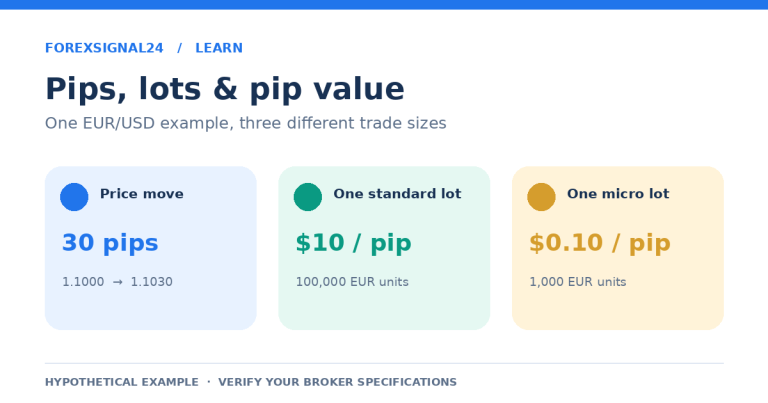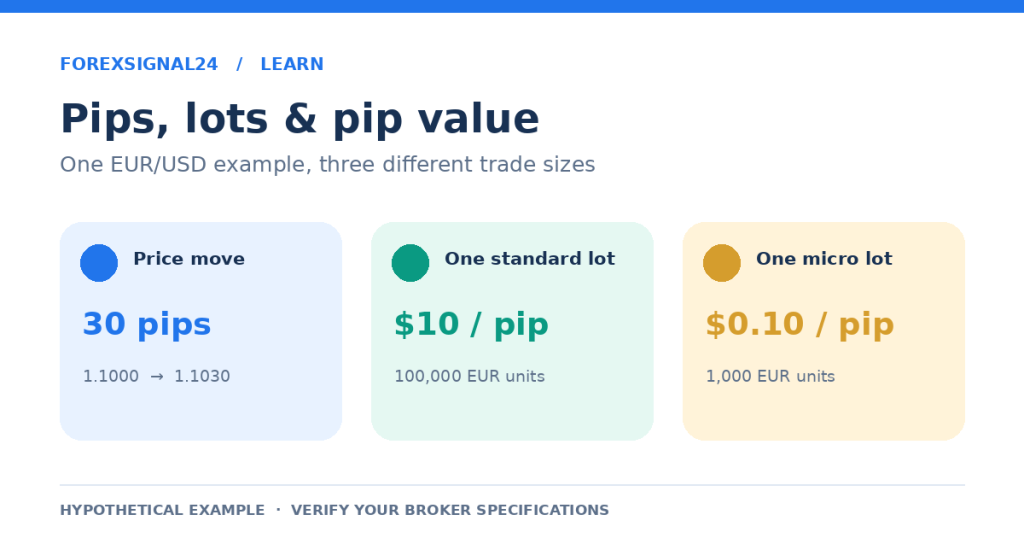
A 30-pip move sounds specific until you ask what it means in money. On EUR/USD, it could represent $3, $30 or $300, depending on the position size. Those figures assume a USD account, a 100,000-unit contract per lot and a pip size of 0.0001. The chart movement is identical; the exposure is not.
The ForexSignal24 Pip Value Calculator helps connect those two numbers. Enter your volume, contract specification and currency conversion, and it estimates what one pip is worth for that position. You can then put a monetary figure on a stop distance, compare trade sizes or check the cost of a quoted spread.
This guide walks through the actual fields and four worked examples. All prices, exchange rates and trading conditions below are hypothetical, not live quotes or recommended trades.
What a pip value calculator tells you
A pip describes a price increment. Pip value describes the monetary effect of that increment on a particular position. Confusing the two is how a familiar-looking stop can turn into a larger loss than expected.
The distinction also separates this tool from a position size calculator. Here, you enter the lot size and calculate its value per pip. A position size calculator works backwards from a risk budget and stop distance to estimate the volume. Neither calculation decides whether a trade is worth taking.
The tool uses manual inputs. It does not retrieve live exchange rates, read your account balance or send orders to a broker. Its presets are editable starting points, not verified specifications for your trading account. For the underlying terminology, our guide to forex pips, lots and pip value covers the foundations.
The formula behind the result
For the linear forex calculations used here:
Pip value in account currency = lots × contract size × pip size × conversion rate
Contract size is the number of base-currency units represented by one lot. Pip size is the price increment you want to measure. Conversion means account-currency units per one unit of quote currency; the quote currency is the second currency in the pair.
For 0.10 lot of EUR/USD in a USD account, using a 100,000-unit contract and a 0.0001 pip:
0.10 × 100,000 × 0.0001 × 1 = $1 per pip.
That is the value for the entire 0.10-lot position, not for each full lot. Do not multiply the result by 0.10 again. A 30-pip movement has a $30 price-based effect under these assumptions; whether it is a gain or a loss depends on the trade direction.
How to use the ForexSignal24 Pip Value Calculator
Open the calculator and review all six fields. For the first EUR/USD example, the inputs are:
| Field | Example input | What to check |
|---|---|---|
| Instrument preset | EURUSD | The instrument whose specifications you are entering |
| Account currency label | USD | The denomination used for your calculation |
| Lot size | 0.10 | Volume in lots, not currency units |
| Contract size (base units per lot) | 100000 | Units represented by one lot of this symbol |
| Pip size (quote price increment) | 0.0001 | The price increment counted as one pip |
| 1 quote currency unit = account currency | 1 | One USD is one USD in this example |
The preset list includes EURUSD, GBPUSD, USDJPY, GBPJPY and XAUUSD, plus Custom specifications. Use Custom for a different instrument and enter its specifications yourself. Review the numerical fields whenever you change the preset.
For the contract details, open Market Watch in MetaTrader 5, right-click the symbol and select Specification. Check the contract size, tick size and permitted trading volumes against your broker’s settings. MetaQuotes’ symbol-specification documentation explains these parameters. A calculation does not establish that your broker accepts the volume you entered.
Take particular care with pip size. Under the conventions in these examples, EUR/USD uses 0.0001 and USD/JPY uses 0.01. An extra displayed decimal can represent a fractional pip, not a change in the conventional pip size. OANDA’s explanation of pips and pipettes illustrates the distinction.
Press Calculate after checking the inputs. For the table above, the formula gives $1 per pip. Recalculate after changing any field, and keep full precision in subsequent calculations rather than multiplying an already rounded display value.
Changing the account-currency label does not perform a conversion. Typing EUR instead of USD leaves you responsible for updating the separate conversion input. This is the field to check first when a cross-currency result looks wrong.
Four examples you can work through
1. EUR/USD: the same 30 pips at three lot sizes
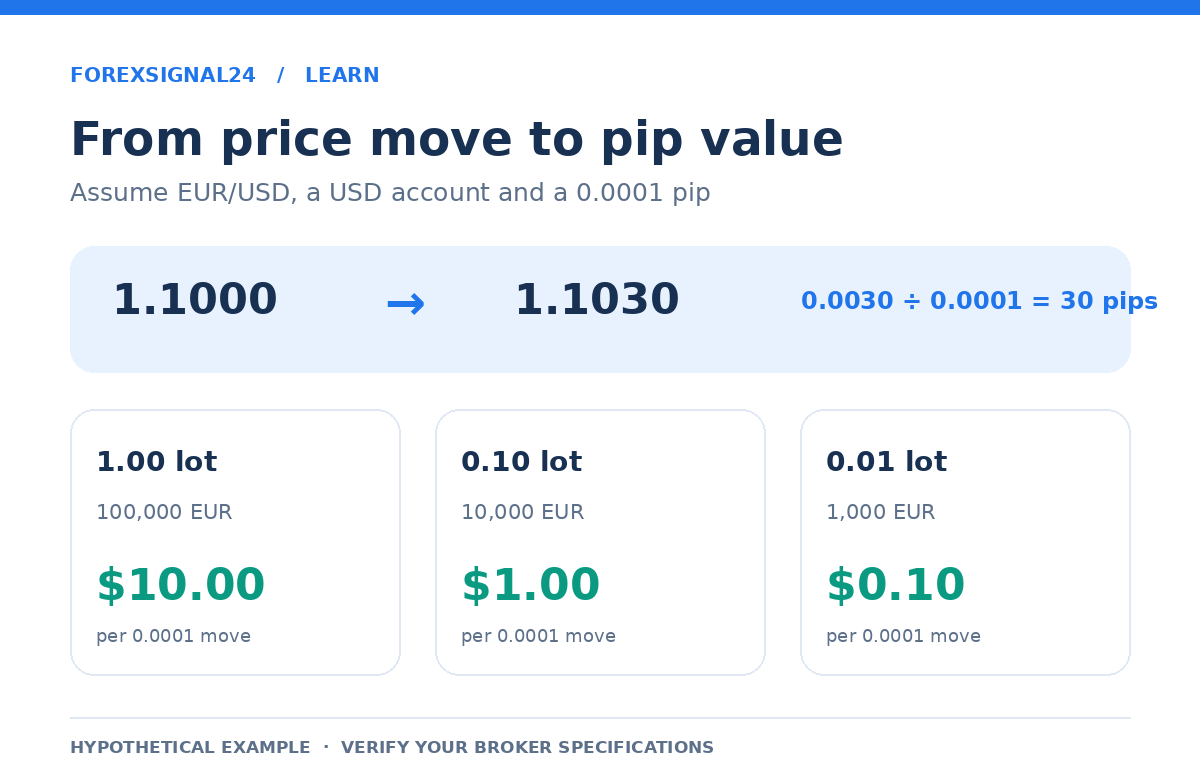
Keep the EUR/USD specifications and USD account from the table. A hypothetical move from 1.1000 to 1.1030 is 30 pips. Changing only the lot size changes the money represented by that move:
| Lot size | Base-currency units | Value per pip | 30-pip price effect |
|---|---|---|---|
| 0.01 | 1,000 EUR | $0.10 | $3 |
| 0.10 | 10,000 EUR | $1.00 | $30 |
| 1.00 | 100,000 EUR | $10.00 | $300 |
The table shows the magnitude of the price-based change, before separate charges or execution differences. A favourable move produces a gross gain; an adverse move produces a loss. There is no account balance in this calculation, so it cannot tell you whether any of these volumes suits your circumstances.
2. USD/JPY: convert yen into the account currency
Select USDJPY, enter 0.10 lot, a 100,000-unit contract and pip size 0.01. Keep the account label USD. Now assume 1 USD = 160 JPY. The conversion field needs the dollar value of one yen: 1 ÷ 160 = 0.00625.
One pip is worth 0.10 × 100,000 × 0.01 = ¥100 for this position. Converting it gives ¥100 × 0.00625 = $0.625 per pip. A 30-pip move has an estimated $18.75 effect when that conversion is held constant. Use $0.625 in the multiplication, not a rounded $0.63.
Entering 160 in the conversion field reverses the rate and produces a meaningless dollar result. Leaving it at 1 is wrong too: it treats one yen as one dollar. In a real trade, the conversion may change before the position closes.
3. EUR/USD in a EUR account
Return to EURUSD with 0.10 lot, contract size 100000 and pip size 0.0001, but change the account label to EUR. Assume 1 EUR = 1.10 USD. Since the pair’s quote currency is USD, enter the euro value of one dollar: approximately 0.90909091.
The position still represents $1 per pip in quote currency. In the account currency, it is approximately €0.9091 per pip. A 50-pip move therefore represents about €45.45 at the assumed conversion, not €50. The exposure has not changed simply because the result is expressed in another currency.
4. EUR/GBP in a USD account
A pair does not need to contain USD for its pip value to be calculated in dollars. Choose Custom specifications for this EUR/GBP example. Enter 0.20 lot, contract size 100000, pip size 0.0001 and account label USD. Assume 1 GBP = 1.25 USD, so the conversion input is 1.25.
The calculation is 0.20 × 100,000 × 0.0001 × 1.25 = $2.50 per pip. A 40-pip movement represents $100 before costs, with the conversion held fixed. The rate is not inverted here because it already expresses the account-currency value of one unit of quote currency.
The rule is the same in every example: identify the second currency in the pair, then ask what one unit of it is worth in the account currency.
Turn the result into a useful trading check
Translate a stop or target into money
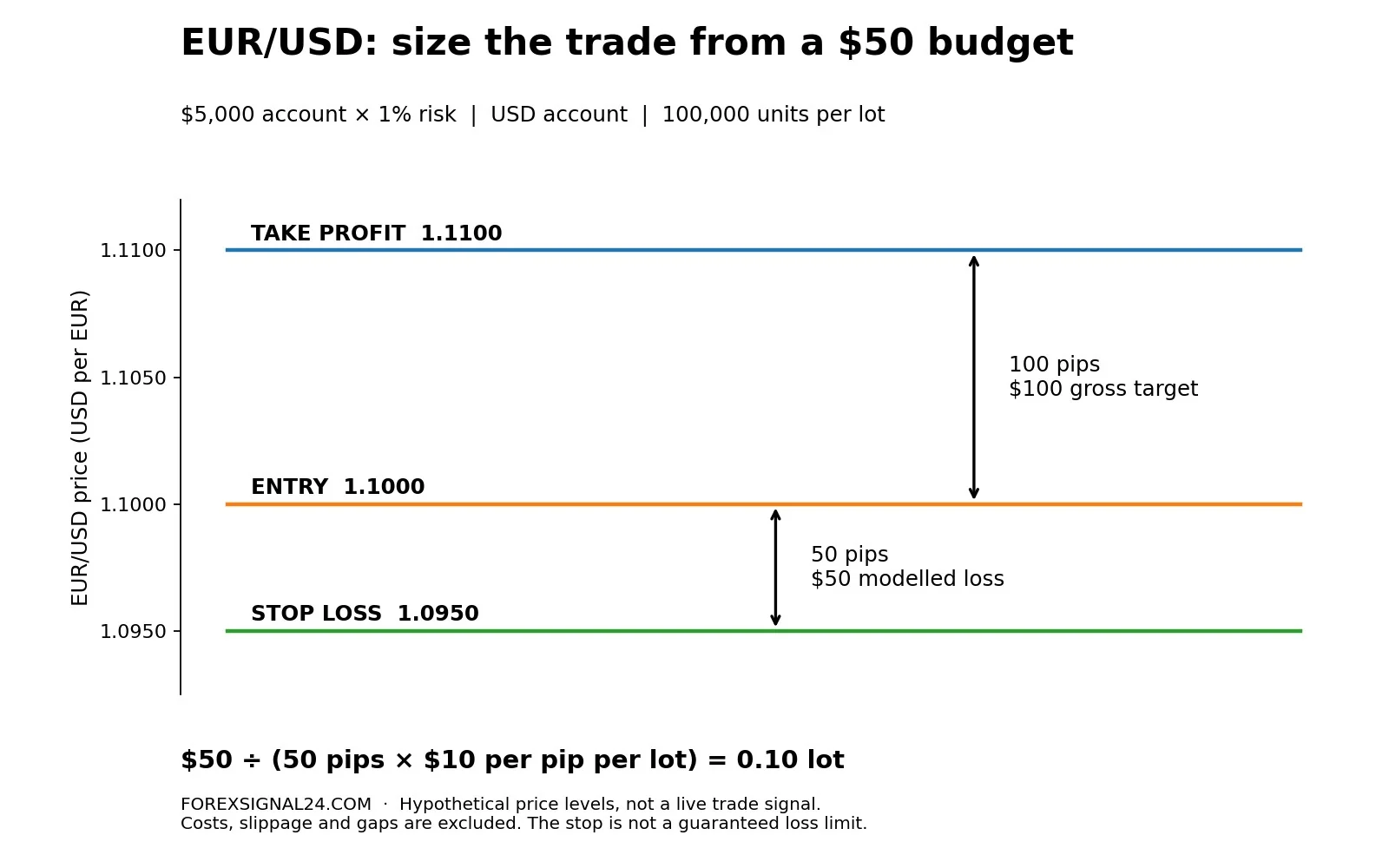
At $1 per pip, a 50-pip stop represents $50 of modelled price risk, while a 100-pip target represents $100 of gross potential reward. These are estimates, not guaranteed outcomes.
For a concrete EUR/USD buy example, entry at 1.1000, stop at 1.0950 and target at 1.1100 produce those distances. With a 0.10-lot position and the USD-account specifications above, the diagram connects each level to its monetary effect.
When you need to determine the volume rather than check an existing one, use the Position Size Calculator. Our step-by-step position sizing guide explains the additional inputs and lot rounding.
Put a price on the spread
Suppose 0.20 lot of EUR/USD is worth $2 per pip under the same specifications. A hypothetical 1.2-pip spread then represents $2.40. A separate round-trip commission of $7 per lot would add $1.40 at that volume, giving a $3.80 spread-and-commission estimate.
The Spread & Commission Calculator handles that next step. Keep the price basis consistent: when you calculate profit or loss from actual executable entry and exit prices, the spread is already reflected in those prices. Do not subtract it a second time.
Mistakes the formula cannot fix for you
Mixing lots with units. With the assumed 100,000-unit contract, 10,000 units means 0.10 lot. Typing 10000 into the Lot size field describes 10,000 lots, not 10,000 units. Check the broker’s contract definition, especially for cent or nonstandard accounts.
Mixing pips with points. Entering 0.00001 instead of 0.0001 for the EUR/USD convention used here calculates the value of a tenth of a pip. A numerically correct answer can still describe the wrong unit.
Treating every market like EUR/USD. The familiar $10-per-pip figure applies to one full lot only under specific contract, pip and account-currency assumptions. Gold needs particular care: the XAUUSD preset does not establish a universal gold pip or contract size. Read our XAUUSD contract-size guide before transferring forex assumptions to metals.
Calling an estimate a maximum loss. The calculation does not include commissions, financing, slippage or gaps, and it holds the entered conversion rate fixed. A normal stop is not a guaranteed execution price. The CFTC/NASAA forex investor alert is a useful reminder that currency trading can be highly risky even through a reputable dealer.
Frequently asked questions
Does leverage change pip value?
Not for a fixed lot size, contract, pip increment and conversion rate. Leverage is not an input in this formula. Taking a larger position increases pip value; changing leverage alone does not. Check funding requirements separately with the Margin Calculator and your trading platform.
Does the tool use current market rates?
No. This pip-value form has no live exchange-rate feed. You supply the quote-to-account conversion and contract specifications yourself. The values already on the page are examples, not fetched market quotes.
Why does my platform show a slightly different amount?
Compare the volume, contract specification, pip or tick increment and conversion used. Display rounding, a different conversion rate or account denomination may explain the difference. For net profit and loss, also check which costs are already included in the platform figure.
Does the result tell me how many lots to trade?
No. It values the lot size you supplied. Choosing a position also requires a risk budget, a stop distance, broker volume limits and a review of the rest of your account.
Give the next pip a monetary value
Before your next planned trade, check what one pip represents, then multiply it by the stop distance. Repeat with a smaller lot size. That comparison makes the exposure easier to judge than looking at a volume number alone.
Open the ForexSignal24 Pip Value Calculator and work through one of the hypothetical examples above. The goal is not to make the trade look affordable. It is to understand the numbers before deciding whether to trade at all.
Educational information only, not personalised investment advice or a trade signal. Forex and leveraged trading involve substantial risk of loss. All examples are hypothetical, and calculations do not guarantee execution, profitability or a maximum loss.