An economic calendar tells you when potentially important data may arrive. It does not tell you whether EUR/USD will rise after the release. A language model can help organize an event checklist, but it should not be treated as a live quote feed or a source of certain forecasts.
The useful role for AI is narrower and more testable: make the assumptions clear, distinguish known facts from possible reactions, and identify which inputs still require verification.
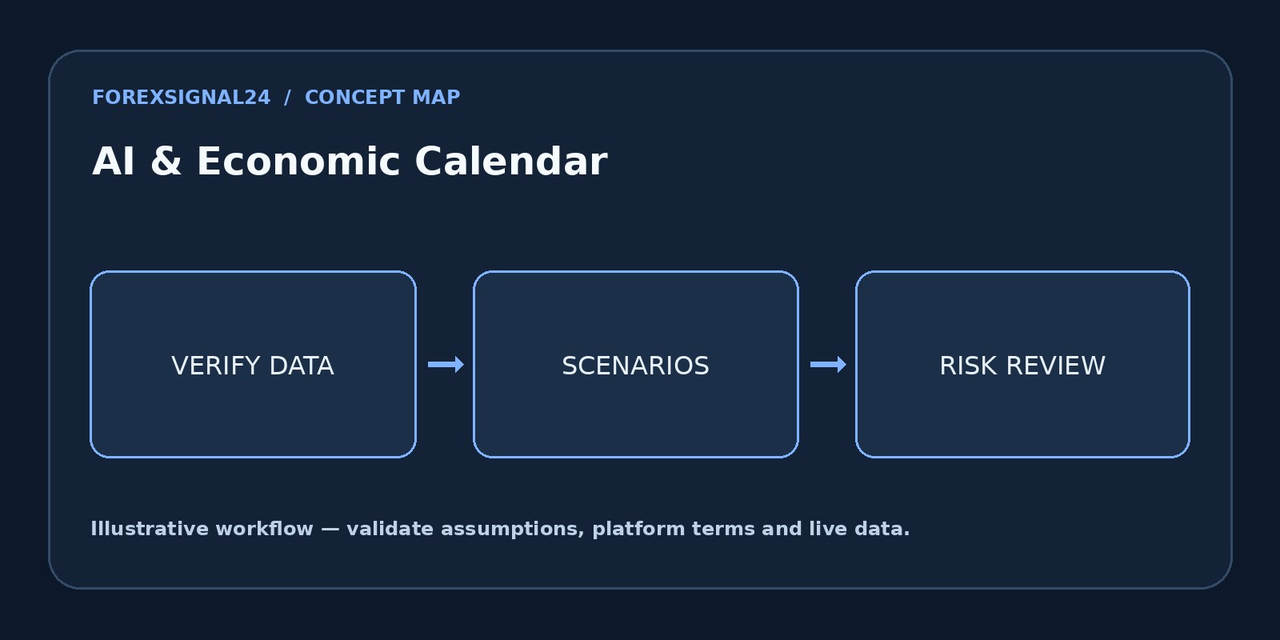
Step 1: collect the event details yourself
Open a reliable calendar and record the event name, release time with timezone, currency, prior reading, market expectation, and source publication link. For example, US nonfarm payrolls or consumer-price data may appear at specific US times that change relative to other regions during daylight-saving transitions.
Use the ForexSignal24 Market Data & Calendar as a starting point. Verify material figures against the original statistical agency or central bank. If the values have not yet been published, label them as consensus estimates, not actual observations.
Step 2: ask AI for a scenario map, not a signal
A more disciplined prompt sounds like this:
"Using only the verified figures I provide, summarize what this release measures, identify plausible upside and downside surprises, and list the assumptions that could change the market reaction. Do not predict a candle, invent quotes, or recommend a trade. Mark unavailable information explicitly."
The aim is a decision framework, not a buy/sell arrow. A CPI beat could matter differently when central-bank expectations, wage trends or market positioning have changed. AI-written narratives can sound confident even when they rest on missing data.
Step 3: produce a small decision table
| Before release | Immediately after release | After the initial move |
|---|---|---|
| Verify event timing and actual source | Re-check spread and price availability | Compare reaction with the prewritten scenarios |
| Set maximum monetary risk | Avoid assuming stops fill exactly | Note what the scenario framework missed |
| Review correlated positions | Pause if execution conditions are unclear | Record observations in the journal |
A responsible calendar workflow allows the decision not to trade. During major releases spreads and slippage can change the relationship between intended stop distance and realized losses. Read the site’s news trading risk guide before applying a calculated position size around a release.
Step 4: use AI for an after-action review
Once verified actual data is available, you can ask AI to compare your original scenarios with the observed release and your own notes. Provide anonymized, nonsensitive data. Tell the model to separate evidence, inference and unknowns in the output.
A useful review asks whether the plan captured the relevant factors, not whether the AI ‘guessed the direction.’ This is aligned with the NIST guidance on generative AI risk, which highlights the need to manage inaccurate and fabricated outputs.
Controls worth keeping in place
Never share account credentials, API keys or personal financial records in a prompt. Do not paste a chart screenshot and assume the model can identify the current executable spread, live liquidity or your broker’s order-book conditions. Do not let a persuasive paragraph replace arithmetic. Run the final stop-distance and position-size checks using the Position Size Calculator.
Quick questions
Can AI predict NFP or CPI price movements?
It can generate scenarios or analyze historical relationships, but it cannot reliably promise the next forex move, especially when key data is unknown before publication.
What is the best AI output before a news release?
A neutral briefing with confirmed facts, explicit unknowns, scenario assumptions, a risk checklist and links to primary data. If those are missing, the output is not ready for use.
The advantage of AI is structure and speed of review, not an exemption from uncertainty.
Risk notice: Leveraged forex and CFD trading can cause substantial losses. The figures and examples are educational, not current quotes, investment advice or predictions. Verify instrument terms independently.