The famous London–New York overlap is a time window, not a trading signal. To use it well, traders must distinguish local clock times, seasonal shifts and broker-specific market availability.
Two traders read the same article about the “best hours for EUR/USD,” yet their screens show different session times. One lives in a country that observes daylight saving, the other does not. Neither necessarily has a broken clock. The difference comes from converting a financial centre’s local time to the trader’s own timezone.
Forex is a global over-the-counter market. Individual trading centres have characteristic business hours, but a currency pair does not automatically become profitable when two centres are open at once. What changes is the mix of participants and often the intensity of activity.
What does the London–New York overlap mean?
A common educational approximation treats London’s active weekday window as 08:00–17:00 London local time and New York’s as 08:00–17:00 New York local time. Under that convention, the period when both windows are active is 08:00–12:00 in New York local time, although this is an indicative comparison, not a hard market-opening rule.
The US and UK change daylight-saving time on different dates (see the UK government clock-change guide and the US Department of Transportation DST explanation). During the transitional weeks in March and late October or early November, the difference between London and New York clocks can temporarily shift. A static UTC or Jakarta-time table repeated year-round may be wrong for those weeks.
The Forex Market Sessions tool gives an interactive reference for session timing. Use its current timezone conversion alongside a reliable clock and your broker’s published trading schedule.
Why the overlap attracts attention
When traders from both major financial centres participate, there can be more opportunities for a price to move and for orders to interact. Liquidity, volatility and spread are related but not interchangeable. A highly active session can still experience sudden price gaps or widened spreads, especially around major data releases.
Instead of assuming “overlap = better trade,” compare your own execution records. Track median spread at entry, realised slippage, average holding period, and whether the trade followed the strategy rules. The useful finding is not the busiest session in general; it is the session in which your tested approach behaves acceptably after costs.
Session timing example for a trader in Jakarta
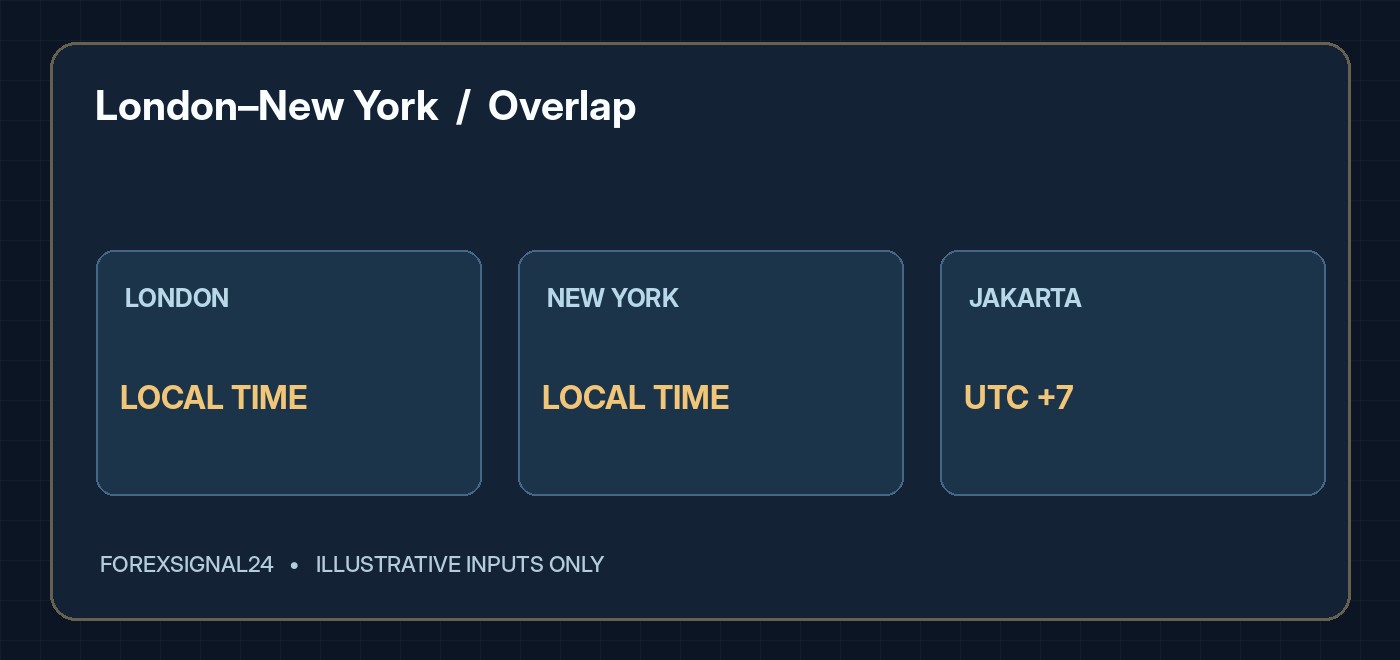
Indonesia’s Western Indonesia Time (WIB) is UTC+7 and does not use daylight saving. When New York operates on Eastern Daylight Time (UTC−4), an illustrative 08:00 New York start corresponds to 19:00 WIB. Under Eastern Standard Time (UTC−5), it corresponds to 20:00 WIB. London likewise moves between GMT and British Summer Time.
These are simple timezone conversions, not instructions that a specific currency instrument opens or closes at those exact moments. Broker maintenance periods, public holidays and weekend schedules remain separate questions.
Build a session-aware workflow
Start with the timezone configured on your trading platform, then check the session reference. Open the Market Data & Calendar before positioning a trade around an economic release. If a strategy uses a 25-pip stop during a relatively quiet period but requires a 45-pip stop in a more volatile period, the same lot size would create a different planned loss. For event-specific execution risks, the companion forex news trading risk guide explains why spreads and fills may change the result.
Recalculate volume with the Position Size Calculator; do not reuse yesterday’s lot size solely because the currency pair is the same. If a plan involves holding a position across the broker’s daily rollover, review possible financing through the Swap Calculator.
Common session mistakes
The most frequent error is memorising a session table without noting which timezone it uses. Another is assuming a major-city session represents an exchange’s exact opening bell. A third is treating a rise in volatility as proof of higher expected returns. None is a sound substitute for evidence from a tested strategy and actual execution records.
FAQ: Is the London–New York overlap always the best time to trade?
No. It can be an active period, but the suitability depends on the instrument, setup, costs, market events and trader’s process. A strategy tested in a quieter session may not transfer unchanged.
FAQ: Why do forex session hours change in my local time?
London and New York observe seasonal clock changes while some countries, including Indonesia, do not. They also change on different calendar dates.
FAQ: Do forex brokers all close at the same minute?
No. Market availability and daily breaks can vary by provider and instrument. Follow the broker’s official trading-hours specification for an order you intend to place.
Times are educational approximations. Verify timezones, bank holidays and broker schedules before trading.