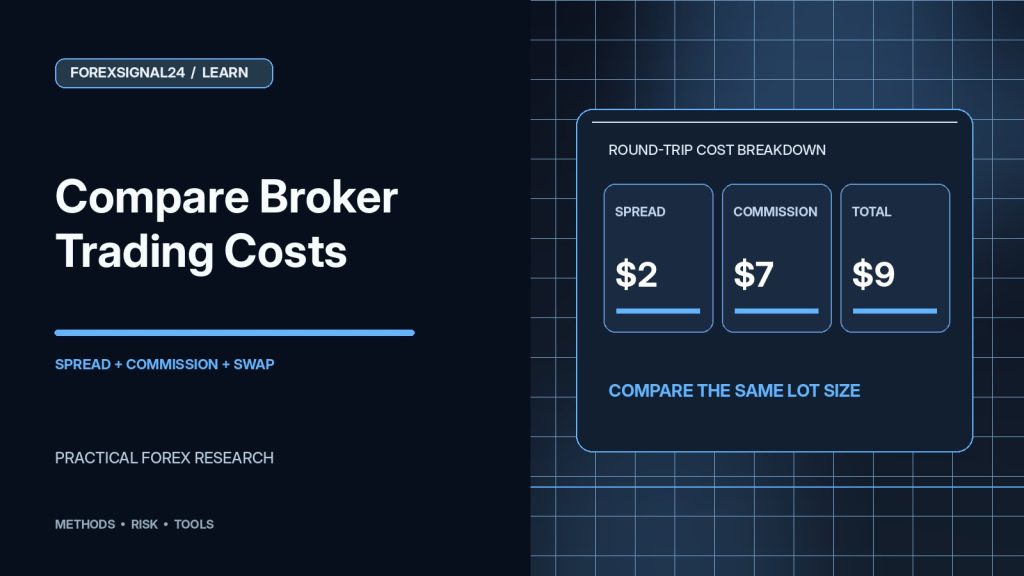
Two accounts can both advertise low spreads and still produce different all-in costs. The comparison only becomes meaningful when the instrument, volume, holding period and commission basis are the same.
A broker’s “spread from 0.0” headline describes a possible starting spread, not necessarily the spread you will receive when entering a trade. It also says nothing on its own about commissions, overnight financing or execution quality. That is why a comparison built from advertisements often reaches the wrong conclusion.
A more useful method is to fix a trading scenario and model each account against the same inputs. This does not produce a universal best broker; it shows which inputs drive the estimated bill.
Start with the same trade
Suppose you want to compare the estimated round-trip cost of opening and closing one standard lot of EUR/USD in a USD-denominated account. For a conventional 100,000 EUR contract and a 0.0001 pip increment, the pip value is approximately $10 per standard lot. Keep this contract assumption explicit: instrument specifications and account currency conversions can change the result.
Now compare the following hypothetical pricing models. These are teaching figures and do not describe any named broker’s current offer.
| Account example | Assumed spread | Commission, round trip | Estimated spread + commission |
|---|---|---|---|
| Spread-based | 1.0 pip | $0 | $10 |
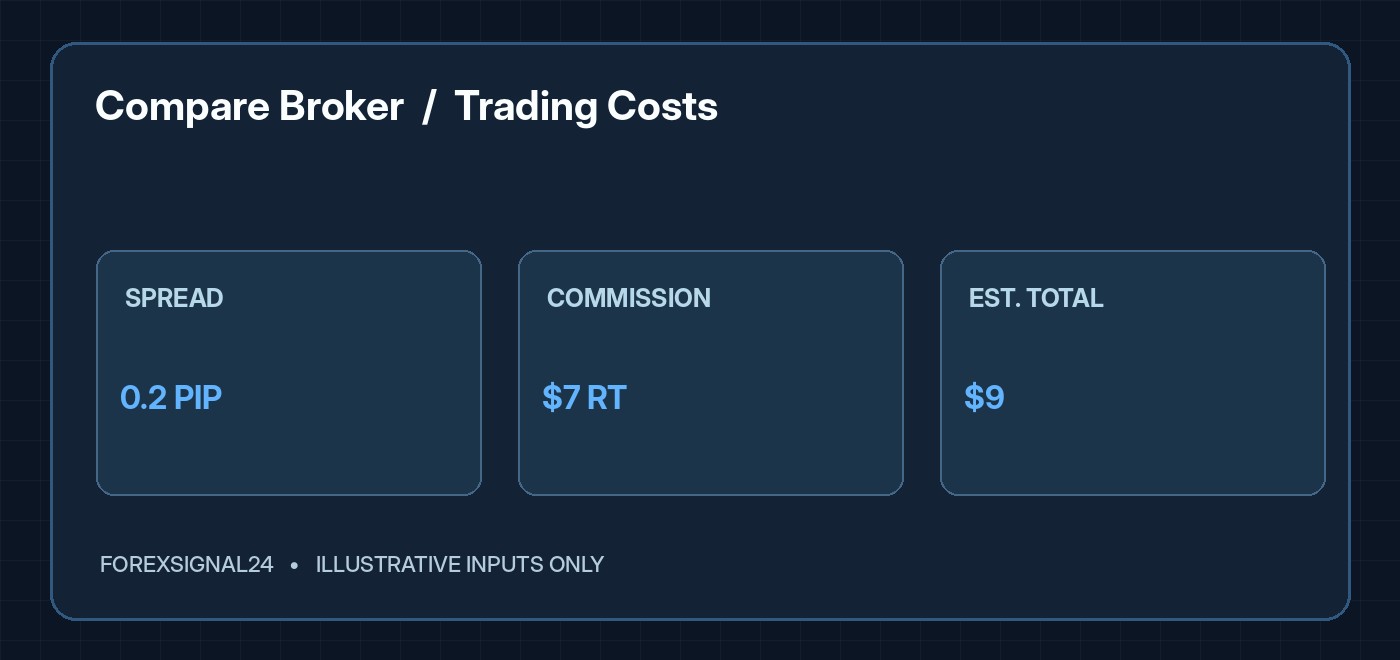
| Raw + commission | 0.2 pip | $7 | $9 |
| Lower-spread / higher-fee | 0.1 pip | $10 | $11 |
The formula used is spread in pips × pip value × lots + round-trip commission. If commission is quoted per side, double it for a completed open-and-close trade. Confusing per-side and round-trip fees can flip the result.
Account for the holding period
For an intraday position that closes before the relevant broker rollover, financing may not apply. For a position held overnight, the estimated cashflow may also include a swap debit or credit, depending on instrument, direction, provider and day of the week. A Wednesday-style triple rollover convention, for example, cannot be assumed for every product or broker.
Use the ForexSignal24 Spread & Commission Calculator for the modelled entry/exit cost and the Swap Calculator for manually supplied overnight-rate scenarios. Review the trading-cost explainer if you want the definitions first.
For a direct account-by-account model, use the ForexSignal24 Broker Account Cost Calculator. Set one instrument, lot size and monthly trade count, then edit published spread and per-side commission assumptions to match your actual broker quotes. Its ranking represents estimated scenario costs, not live executable pricing.
Treat minimum spreads as a reference, not a forecast
Broker marketing pages may quote starting values, typical spreads, or historical averages. Those figures are not interchangeable. Where a cost comparison uses a “minimum basis,” label it accordingly. To compare actual platform conditions, record bid/ask quotes from the same period and inspect how prices behave around illiquid hours or events.
The ForexReview broker cost comparison hub provides a separate research workflow for side-by-side account costs. Its assumptions and verification labels should be checked before using its values as evidence; the True Trading Cost Calculator can help explore how different parameters affect modelled results.
Execution may overwhelm a small advertised advantage
A $1 difference in the modelled round-trip bill is useful to know. For an example of how quickly execution assumptions can change during economic releases, read the news-trading risk walkthrough. It can also be smaller than the cost of a modest adverse fill. Slippage is neither always negative nor always positive, and it cannot be responsibly reduced to a single guaranteed figure for every trader. Account type, liquidity, order method and trading time influence experience.
When reading a broker review, ask how the spread was measured, whether the quoted commission is per side, which legal entity offers the account, and whether the comparison includes swap or other account fees. Visit the broker’s official contract specification and fee documentation for the final check.
Make the cost comparison match your own behaviour
A short-term trader making many entries may be more sensitive to spread and commission. A swing trader holding positions across rollover may care more about financing. A small account trading tiny volumes may run into minimum lot size or ticket fees. None of these situations has a universal winner.
If you are also considering a broker promotion, compare its restrictions separately. The FreeForexPromo promotions database describes offer terms and eligibility, but a bonus should never be counted as a guaranteed reduction in trading cost.
FAQ: Is a raw-spread account always cheaper?
No. The spread plus the full commission can exceed an all-inclusive alternative. Compare the entire round-trip bill using a consistent instrument and volume.
FAQ: Is the lowest advertised spread the same as the lowest actual spread?
No. A stated minimum is not an execution guarantee or a representative average. The market session and current bid/ask conditions matter.
FAQ: Can I compare brokers using only a calculator?
A calculator is a model. Verify the input values, legal entity, contract size, fee basis and execution policies directly with the provider before drawing conclusions.
The numerical accounts above are fictional examples, not broker ratings or recommendations.