A language model can be a demanding reviewer of your forex plan even when it has no live prices. Ask it to challenge assumptions, surface missing costs and generate adverse scenarios—not to manufacture a confident forecast.
Most traders can write a reason to enter a trade. Far fewer can write down what would invalidate the idea before it happens. That gap is where a careful AI workflow may help. Its useful contribution is structure: making assumptions explicit, detecting contradictions and forcing a decision tree to be written before emotions take over.
Give AI a bounded job, not trading authority
Start with verified facts: the instrument, direction, intended entry, stop, account currency, estimated spread, commission, holding period, nearby economic events and the source and time of your data. Tell the model plainly that it has no authority to infer live prices or add facts you did not supply. Ask for a checklist, not a trade recommendation.
For example, a helpful instruction is: “Audit this EUR/USD trade plan. Separate known inputs from assumptions. Identify five ways the planned loss could be exceeded. Do not predict price direction. Ask for missing contract specifications before calculating dollar risk.” This creates an auditable response that can be checked against your calculator and broker documents.
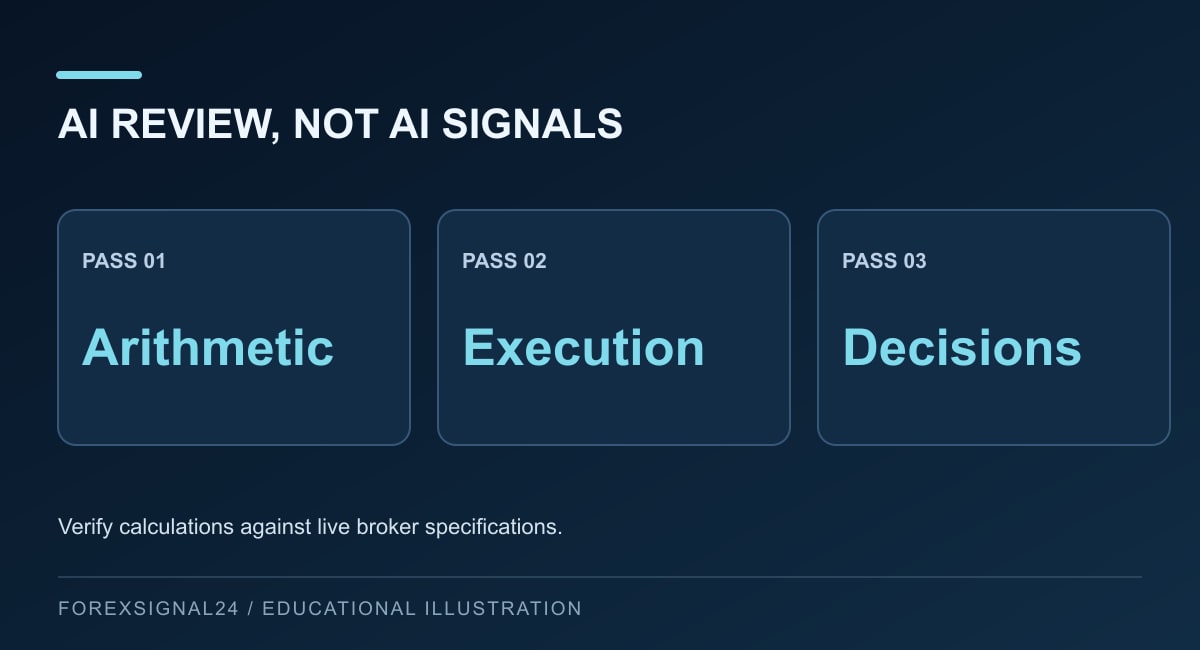
Three useful review passes
Pass one — arithmetic. Verify the relationship between lot size, pip value, stop distance and total planned risk. Confirm whether spread and commission were counted. Never copy an AI-generated pip value into a live order without checking the instrument specifications. The Position Size Calculator provides a separate numerical reference.
Pass two — execution. Ask for scenarios involving spread widening, a late stop fill, a platform interruption and news-time liquidity. A good response distinguishes estimated risk from realized loss. Do not present invented slippage numbers as historical averages.
Pass three — decision rules. Convert discretionary statements such as “exit if momentum looks weak” into observable criteria. If a rule cannot be assessed consistently by a human looking at the chart afterward, the plan is difficult to test fairly.
A repeatable stress-test prompt
Act as a skeptical risk reviewer, not a signal provider. I will supply a proposed forex trade, broker contract details and a dated market snapshot. Identify missing inputs, arithmetic errors, correlated exposures, execution risks and conditions that would invalidate the setup. Separate facts, assumptions and suggestions. Do not invent real-time data or estimate win probability without a sample. End with a five-item pre-trade checklist.
Review the response line by line. If the model cites a regulation or a study, open the original source. If it returns a numerical probability without a documented sample, disregard it. For transparent AI governance principles, consult the NIST AI Risk Management Framework.
Privacy and testing are part of the process
Remove account numbers, names, personal identifiers and platform tokens from prompts. Do not upload raw account statements unless you understand the service’s data handling. Maintain a versioned journal of the prompts, inputs and corrections; otherwise you may mistakenly attribute a good outcome to a prompt that was rewritten after the trade.
The AI Trading Journal guide shows how to turn the output into a systematic review process. The Risk/Reward Calculator can then check setup arithmetic independently.
Frequently asked questions
Can AI accurately predict the next forex candle?
A chatbot does not become a validated forecasting system simply by sounding certain. Backtest any claimed edge with documented historical inputs and out-of-sample evidence.
Should I let AI execute trades automatically?
Not on the basis of prompts alone. Automated execution requires separate safeguards, testing and supervision appropriate to the platform and risks involved.
AI-generated observations are not investment advice or verified live market data.