Two open trades can look diversified because the symbols are different. In practice, a long EUR/USD position and a long GBP/USD position may respond to the same dollar shock. Their combined risk deserves more attention than either ticket alone.
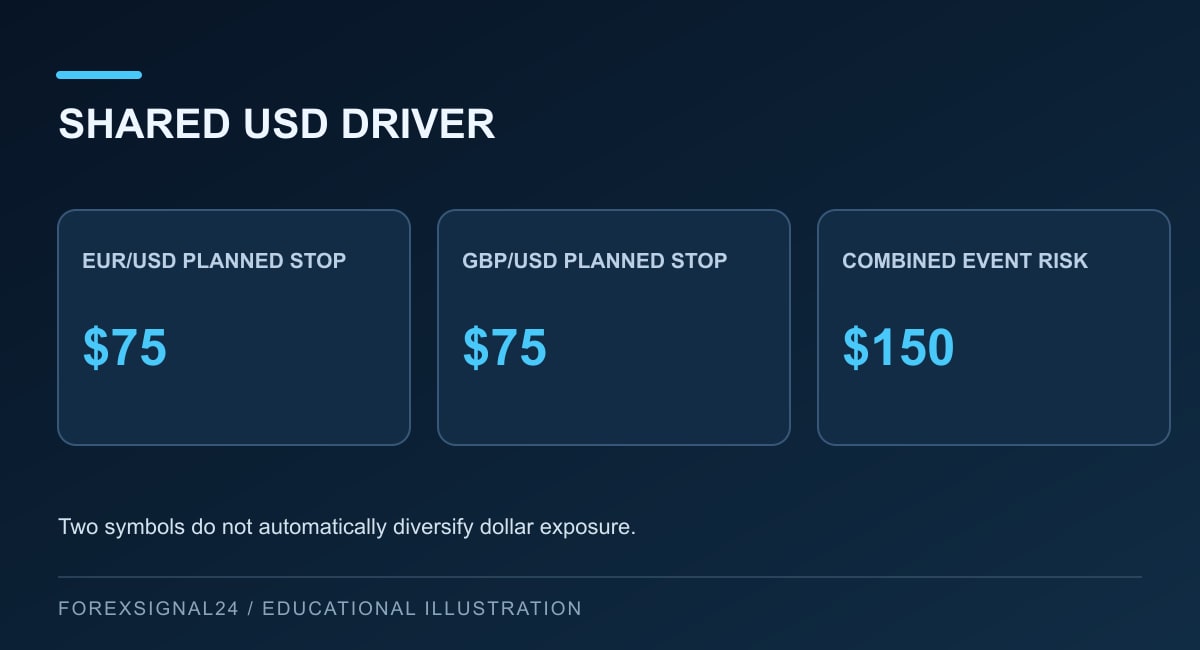
A trader buys EUR/USD with a $75 planned stop loss, then buys GBP/USD with another $75 stop. The positions use two symbols and two chart patterns, but both express a weaker-dollar view. When a US inflation release surprises the market, the two trades can lose together. That is not a mysterious correlation problem; it is an exposure problem.
What currency-pair correlation actually measures
Correlation describes how two series of returns moved together over a chosen historical window. A value near +1 means they tended to move in the same direction; near −1 means opposite directions. It does not say that two prices have the same volatility, pip value or stop distance. Nor does last month’s correlation guarantee how the next news session will behave.
EUR/USD and GBP/USD often share a US-dollar component, but they also have distinct drivers: euro-area policy, UK data and local liquidity. Correlation can weaken or reverse. For practical risk control, start with the economic exposure rather than treating a statistical coefficient as a prediction.
A simple portfolio-risk example
Assume a USD 7,500 account and a policy of risking no more than 1% on all positions opened around one US-data event. The aggregate event-risk budget is $75. The following two trades each satisfy a $75 single-trade ceiling, yet together they carry $150 of planned stop risk if both stops are hit.
| Position | Planned stop risk | Shared driver |
|---|---|---|
| Long EUR/USD | $75 | USD weakness |
| Long GBP/USD | $75 | USD weakness |
| Both trades | $150 | One dollar event can affect both |
This $150 is an arithmetic sum of planned stop losses, not a forecast of maximum loss. Slippage and gaps can make realized losses larger, while different stop placements can make the outcomes diverge. The purpose of the exercise is to avoid spending the same event-risk budget twice.
Three checks before placing the second trade
First, name the driver. Is the new trade another dollar view, another risk-on position, or genuinely different exposure? Write that answer down. Second, sum the planned loss. Use the stop distance, lot size and contract specifications for every open position; the ForexSignal24 Position Size Calculator helps check each individual risk estimate. Third, set a portfolio ceiling. Decide whether the second trade should be smaller, deferred, or rejected.
Correlation tools can help provide historical context, but window length matters. A 20-day reading and a one-year reading can disagree. A novice mistake is to quote a coefficient with three decimal places while ignoring what timeframe it represents and whether it includes high-impact news periods.
When diversification is less than it appears
Buying EUR/USD and selling USD/CHF can also create broadly aligned dollar exposure despite opposite-looking order directions. Conversely, positions that normally offset one another may both become illiquid during a shock. There is no fixed number of pairs that guarantees diversification. Evaluate the direction, stop risk, event calendar and the conditions in which the portfolio would lose together.
The Risk/Reward Calculator can compare setups, but it should not replace an aggregate exposure worksheet. For a related risk-control issue, read how spreads and slippage affect news trading.
Frequently asked questions
Are EUR/USD and GBP/USD always positively correlated?
No. They often share US-dollar drivers, but the relationship changes with economic news and the measurement window.
Does a hedge remove all risk?
Not necessarily. Different contract sizes, execution costs and time-varying correlations leave residual exposure. A hedge needs its own risk calculation.
Educational examples only. Forex trading involves leverage and may produce losses beyond a planned stop.