A broker can display a familiar regulatory logo on its website while your actual trading account belongs to a different legal entity. That distinction matters more than the marketing banner.
Before depositing, identify the contracting company in the client agreement, verify that specific company in the regulator’s official database, and check what type of activities its authorisation covers. Similar company names are not proof that the account is protected by the same rules.
Start with the legal entity, not the brand
A broker group may serve clients through several subsidiaries incorporated in different jurisdictions. Look for the legal company name, registration or licence number, address, and the governing entity in your account-opening terms. If the homepage says a group is regulated in one country, that does not automatically mean your individual account is booked under that licence.
Take the legal details directly from the contract, not an affiliate comparison table, screenshot or promotional badge. If they are missing, pause and request clarification before making a transfer.
Search the regulator’s original register
Open the regulator’s official website yourself. For UK claims, the FCA Financial Services Register is the place to verify authorised firms and relevant details. Other jurisdictions have their own registers. Enter the full legal entity name and, where available, its licence or registration number.
Check whether the status is current, whether the relevant service is permitted, and whether the address or domain information is consistent. Be cautious of ‘clone’ firms that copy names or licence numbers belonging to legitimate companies.
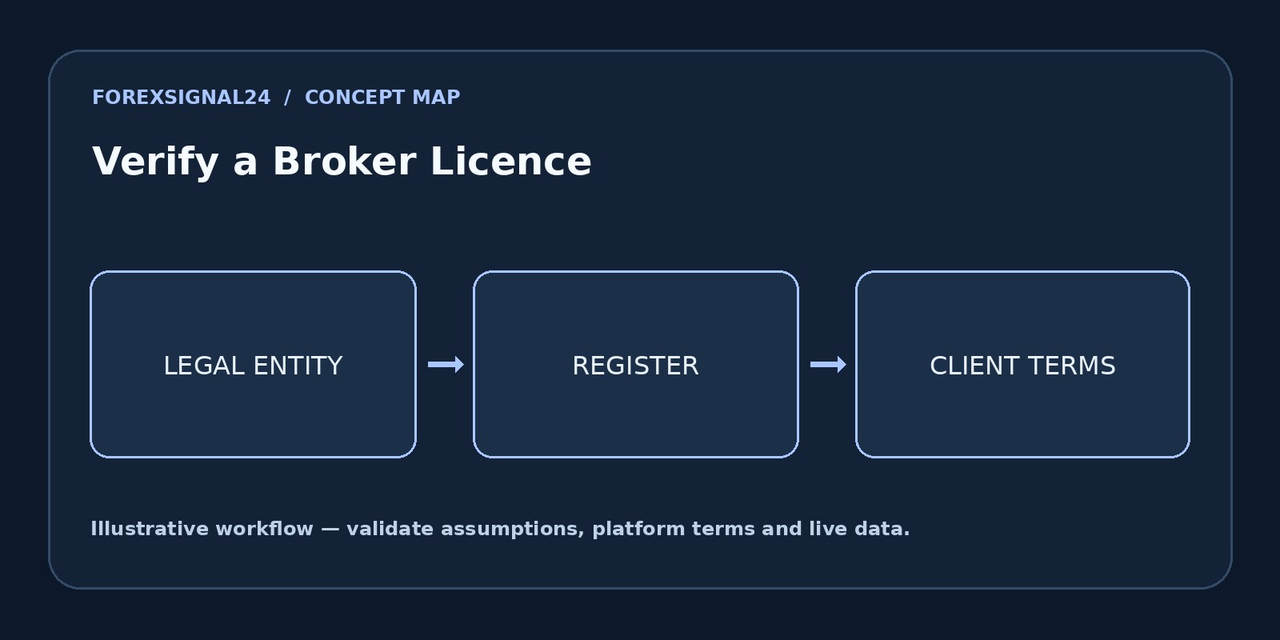
A four-stage verification worksheet
| Question | What to collect | Why it matters |
|---|---|---|
| Who holds the account? | Legal company in client terms | Protection follows the entity, not a logo |
| Is it registered? | Official regulator record | A copied licence number is not enough |
| What may it do? | Permissions and restrictions | Some registrations do not authorise retail forex services |
| What applies to you? | Country, compensation, segregation terms | Protections vary among jurisdictions |
Next, review client money arrangements, complaint routes, negative balance protection, and whether compensation schemes actually cover the product. Never equate ‘registered company’ with ‘regulated forex broker’ without checking the scope.
Then compare practical trading conditions
Regulatory verification is a safety-screening step, not a substitute for reviewing spreads, swap charges, margin rules and withdrawal terms. A licensed firm can still offer products that are inappropriate for an individual trader.
Use ForexSignal24’s Broker Finder to organize preliminary research, but make the official regulator record the deciding source for legal status. To compare account terms with those of other firms, use the Compare Forex Brokers page. For a separate broker-review perspective, ForexReview’s broker directory may help identify additional questions. Its descriptions should also be verified against authoritative documents.
Questions worth asking before funding
Is regulation at the group level sufficient?
Not necessarily. You need to know which regulated or unregulated legal entity is the contractual counterparty for your account, and which jurisdiction governs it.
Does a licence guarantee that deposits are safe?
No. Rules, insolvency protections, segregation arrangements and applicable compensation schemes differ. Regulatory status is an important check, not a guarantee against loss or business failure.
The practical rule: if you cannot confirm the contracting entity and its authorisation using original records, do not treat a marketing logo as adequate proof.
Risk notice: Leveraged forex and CFD trading can cause substantial losses. The figures and examples are educational, not current quotes, investment advice or predictions. Verify instrument terms independently.