
A trading strategy can win more often than it loses and still lose money. The reason is simple: win rate cannot be evaluated without the size of the average win, the size of the average loss, and trading costs.
The popular formula 1 ÷ (1 + reward-to-risk ratio) is a useful starting point only when the ratio represents the actual net average win compared with the actual net average loss. A planned 2:1 target is not necessarily a realized 2:1 result.
The break-even formula
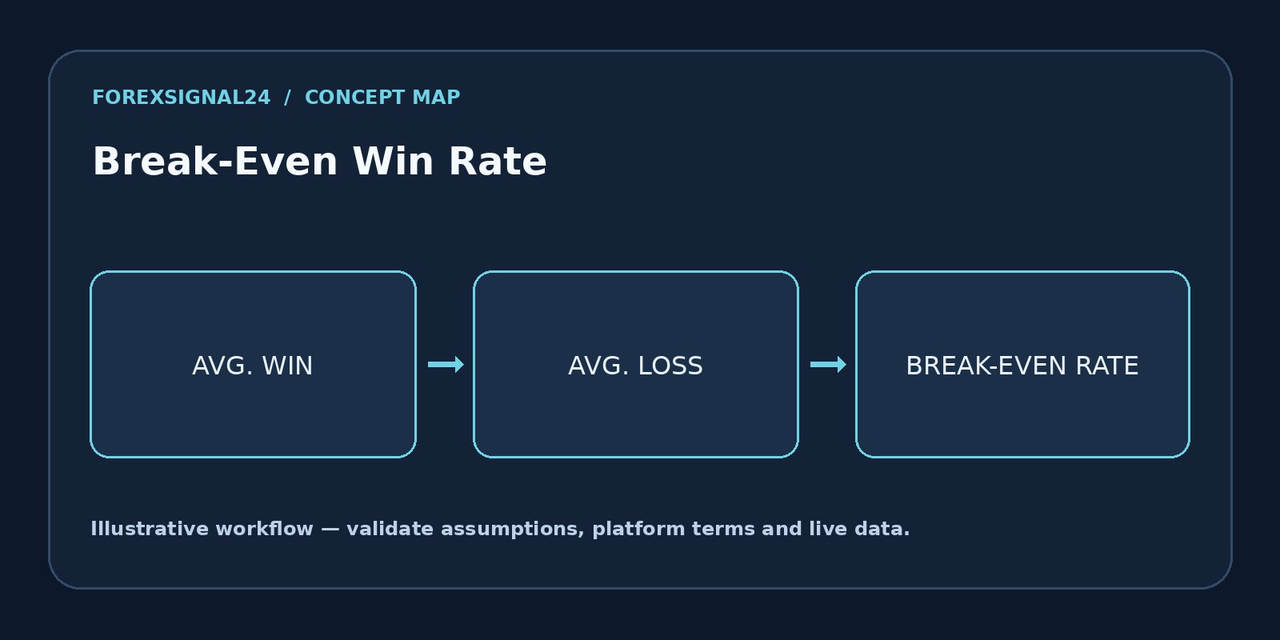
Let W be the average realized net winning trade and L be the absolute value of the average realized net losing trade. Then:
Break-even win rate = L ÷ (W + L) × 100%.
The word net matters. Include the cost of spread, commission, slippage and relevant overnight fees in the realized P/L figures. Then the formula reflects the strategy’s actual economic outcome instead of its chart-only target.
Worked example with different cost assumptions
Suppose a strategy aims to earn $150 on a winning trade and lose $100 on a losing trade before transaction costs. Imagine the same dollar cost is incurred per completed trade, regardless of outcome.
| Cost per trade | Net average win | Net average loss | Break-even win rate |
|---|---|---|---|
| $0 | $150 | $100 | 40.0% |
| $10 | $140 | $110 | 44.0% |
| $20 | $130 | $120 | 48.0% |
| $30 | $120 | $130 | 52.0% |
The $20 row uses 120 ÷ (130 + 120) = 48%. These costs are hypothetical. In actual trading, slippage and financing can vary significantly across positions and market conditions.
Why backtests often overstate the edge
Many backtests measure the distance between a theoretical entry and exit without reproducing changing spreads, delayed fills, commission, financing or missed orders. Their calculated win rate may be accurate for the simulated trades but not representative of real execution.
A second problem is selection bias. A strategy tuned repeatedly to the same historical prices can appear unusually strong without performing comparably on unseen data. If you are validating a rule-based strategy, consult the site’s backtesting guide for practical checks.
Calculate expectancy, not just win percentage
For a strategy with win probability p, the simple per-trade expectancy is p × average net win − (1 − p) × average net loss. At a 50% win rate, a net average win of $130 and net average loss of $120 produces a hypothetical $5 expected gain per trade, before sampling uncertainty and other operational effects.
Such an estimate says nothing about the path of returns. A trade sequence can contain long losing streaks even when its arithmetic average is positive. Use the Risk/Reward Calculator to test initial assumptions and the Trading Cost Calculator to challenge unrealistic friction estimates.
Frequently asked questions
Is a 60% win rate good in forex?
Not automatically. If the average loss is much larger than the average win, 60% can still be insufficient after costs.
Can I use a target risk/reward ratio in the formula?
Only as a planning approximation. For performance review, calculate the ratio from your actual net winning and losing trades, not the original targets.
The most important improvement is to keep a clean trade sample that records both outcomes and transaction costs. That turns break-even math into a decision tool instead of a marketing statistic.
Risk notice: Leveraged forex and CFD trading can cause substantial losses. The figures and examples are educational, not current quotes, investment advice or predictions. Verify instrument terms independently.