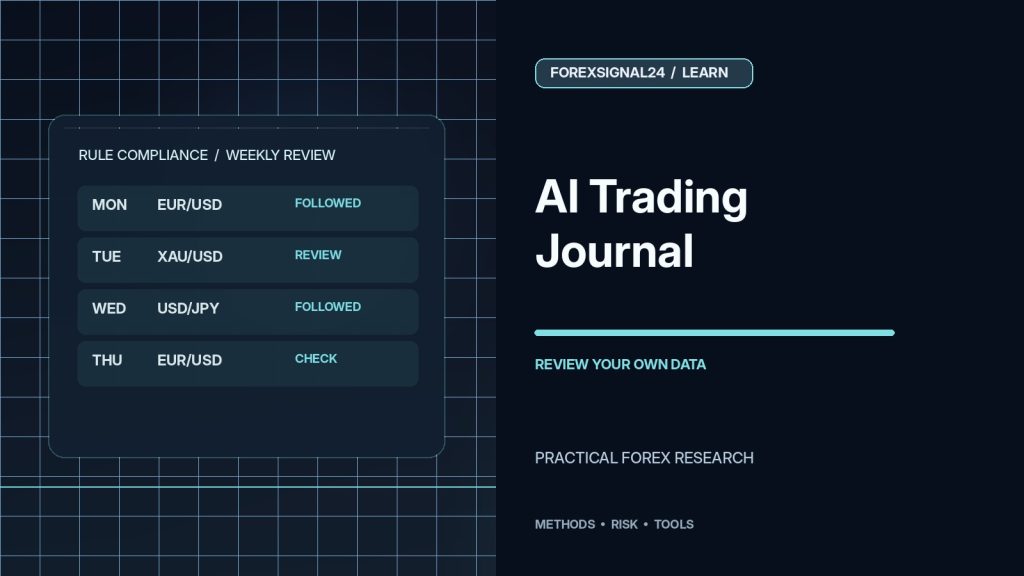
A trading journal should make behaviour measurable, not just collect colourful screenshots. AI can help find inconsistencies in your own notes, provided you keep its conclusions tied to recorded evidence.
After a month of trading, it is common to remember a dramatic winner, a frustrating stop-out and very little about the trades in between. Memory tends to emphasise unusual outcomes. A structured journal does the opposite: it records the routine decisions that actually make up a trading process.
You can maintain the journal in a simple spreadsheet. An AI assistant is optional. Its best role is to organise, label and summarise the evidence you provide—not to invent a reason for every candle or retroactively justify a losing trade.
Start with a compact, consistent set of fields
For every trade, capture the instrument, date/time with timezone, session, setup name, entry, original stop, target, planned monetary risk, actual fill, exit, fees, financing, realised result, and a note on whether your written rules were followed. If you modify a stop or target, record the change and reason separately from the original plan.
| Field | Why it matters |
|---|---|
| Original stop and lot size | Rebuilds planned price risk |
| Entry and exit fills | Separates intentions from execution |
| Spread, commission, swap | Prevents a gross result being mistaken for net |
| Setup and rule compliance | Allows comparison of like-for-like trades |
| Screenshot before entry | Reduces hindsight editing |
Use the Position Size Calculator when you record the intended exposure and the Risk / Reward Calculator for the planned price distances. The risk/reward explanation distinguishes a ratio from the probability of success.
Three prompts worth keeping
Prompt 1: Clean the journal. “You are reviewing a CSV of hypothetical trades. Identify rows missing an entry time, original stop, fee field or exit reason. Do not infer missing values. Return the row identifiers and required corrections.”
Prompt 2: Check rule adherence. “Use only my recorded setup rules and trade notes. Mark each row followed / deviated / uncertain, include a short evidence quote from the row and leave uncertain cases for human review. Do not label a losing trade as a mistake unless the recorded rules were broken.”
Prompt 3: Write a weekly review. “Summarise execution costs, planned versus realised risk, most frequent deviations and open questions. Separate numerical findings from hypotheses. Do not make a trade recommendation or invent external market events.”
These prompts are specific enough to be useful and narrow enough for an editor to challenge. When the model produces a percentage, independently check the numerator and denominator. Ask to see which rows support the statement.
What a weekly review should answer
Choose a small set of questions: Did position sizes align with the initial risk budgets? Which setups occurred often enough to examine? Did spreads or slippage dominate losses in any session? Were stops moved after entry without a documented rule? Were missed trades treated differently from executed ones?
A short written summary of these questions is more actionable than a page of generic affirmations. Beware of interpreting a small sample as proof that a strategy is profitable. Ten similar trades during one market phase are not ten independent guarantees of future behaviour.
Protect credentials and account information
Before uploading any export, remove account identifiers, names, addresses, card information, passwords, access tokens and unnecessary balance details. Consider whether a third-party AI provider retains data or uses submissions for service improvement, and consult its current privacy controls. For a general framework on managing AI risks, see the NIST AI Risk Management Framework. Share the minimum information needed for the analysis.
Do not connect an AI agent to live order execution just to make journal reviews convenient. The safeguards needed for an automated trading system are substantially greater than those needed for reviewing a text file.
Add one verified improvement each week
Rather than changing an entire strategy after a disappointing result, choose a checkable process change: record the original spread at entry, attach pre-trade screenshots, or add an event calendar field. Revisit the change after another period of consistent logging.
For an AI-assisted pre-trade checklist that uses the same evidence-first approach, read How to Use AI as a Forex Trading Assistant once that article is published.
FAQ: Should an AI model decide whether a trade was good?
It can assess whether a recorded decision followed explicit rules, but it should not judge profitability from outcome alone. One disciplined trade can lose; one poorly planned trade can win.
FAQ: Can AI read broker statements automatically?
Capabilities vary by product. Regardless of how data is imported, remove sensitive fields and validate all calculated totals against the original statement.
FAQ: What if I have only a few trades?
Use the journal to improve completeness and consistency. Avoid strong performance claims until you have enough relevant and reliable observations to support them.
For education and process review only. No journal, prompt or AI assistant can guarantee a trading outcome.