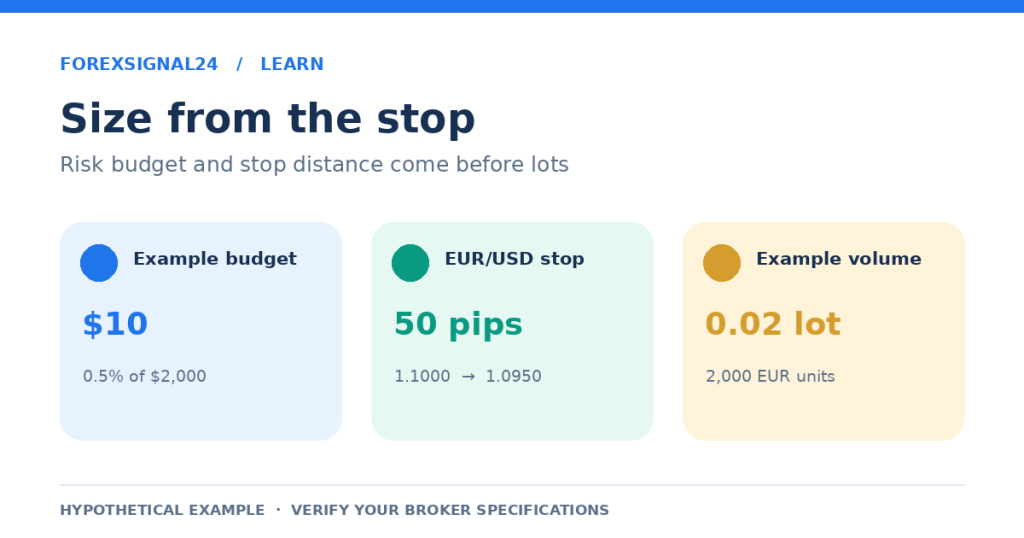
“I have enough margin for this trade” does not answer the more useful question: how much might the position lose if the stop is reached? This guide starts with a stop distance and a chosen monetary risk budget, then calculates a lot size for a hypothetical EUR/USD trade. It builds on the pip and lot definitions and leads into a separate gold contract example. These are teaching figures, not a suggested risk percentage or a live trade setup.
Key takeaways
- Set a stop level for the trade idea, choose a monetary loss budget, then solve for volume. Changing the stop merely to justify more lots defeats the sequence.
- In the worked EUR/USD example, a $10 price risk budget divided by $500 of stop distance risk per standard lot gives 0.02 lot, before costs.
- A stop order and a calculated loss amount cannot guarantee the fill price. Rounding rules, spread, commission and slippage matter.
Begin with the stop and a money limit
CME Group’s education on position size begins with two inputs: the stop location and the account amount a trader is willing to risk. A stop should be placed where the original trade idea no longer holds, subject to the platform’s permitted stop levels, rather than moved to manufacture a desired lot number. The monetary budget is a personal constraint; a percentage in an example does not prescribe what any reader should risk.
Suppose an account contains $2,000. For arithmetic only, choose 0.5% as a sample budget, which is $10. Suppose a hypothetical EUR/USD long trade uses an entry of 1.1000 and a stop at 1.0950. That is a 0.0050 USD per EUR price difference, or 50 pips if one pip is 0.0001. If the stop is not at an appropriate level for a real setup, this arithmetic does not make the setup appropriate.
Calculate the raw lot size
Formula: lots = money risk budget ÷ (absolute entry to stop price distance × units per lot × quote to account currency conversion). With a USD account trading EUR/USD, the quote and account currencies both equal USD, so the conversion factor is one. Assume one lot is 100,000 EUR units: $10 ÷ (0.0050 USD per EUR × 100,000 EUR per lot) = 0.02 lot.
| Step | Hypothetical input or calculation | Result |
|---|---|---|
| Budget | $2,000 × 0.5% | $10 |
| Stop distance | 1.1000 − 1.0950 | 0.0050 USD/EUR = 50 pips |
| One lot at stop | 100,000 EUR × 0.0050 USD/EUR | $500 before costs |
| Raw position | $10 ÷ $500 per lot | 0.02 lot = 2,000 EUR |
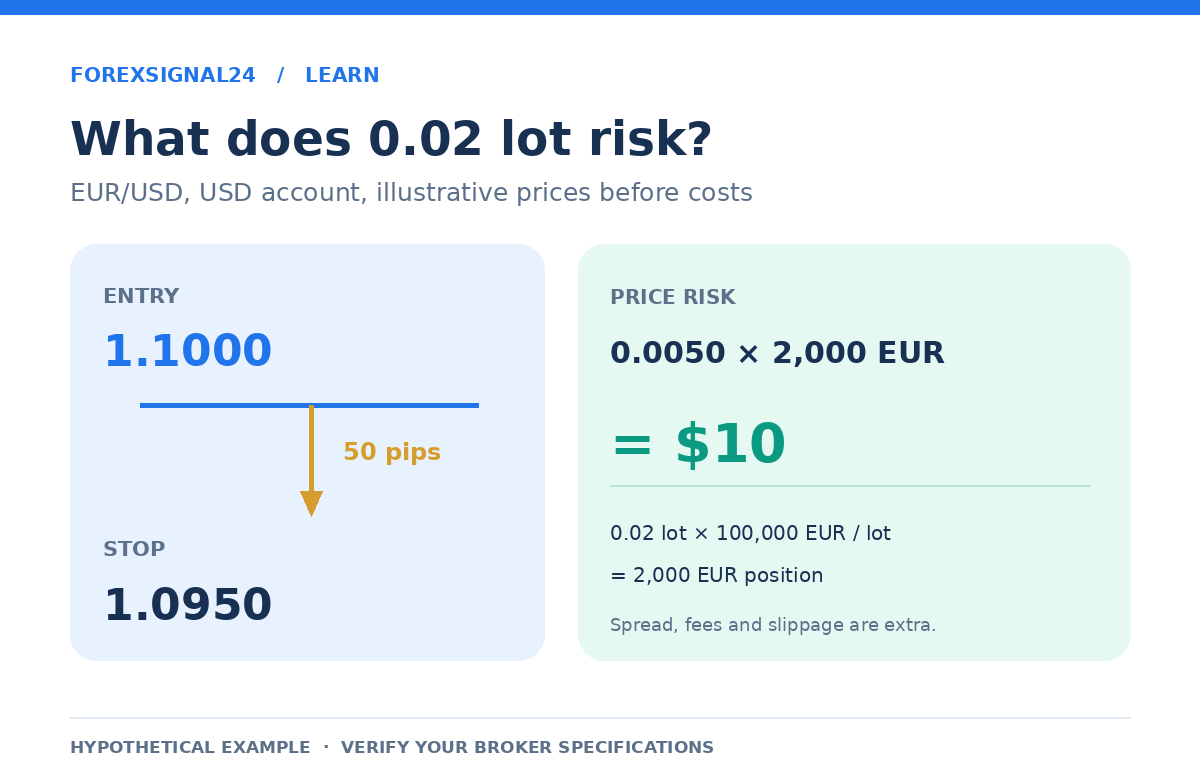
You can check the answer in two ways. First, 0.02 × 100,000 = 2,000 EUR. Second, 2,000 EUR × 0.0050 USD per EUR = $10. In pip terms, the same volume is $0.20 per pip, and 50 × $0.20 = $10. If you are unsure where $0.20 came from, return to the pip value explanation.
Round to the broker’s allowed volume
The raw number is only a candidate. MetaTrader symbol specifications show minimum volume, maximum volume and volume step. A 0.02 lot result fits a symbol allowing 0.01 lot steps, but not every broker offers that step. When the raw result falls between increments, rounding down normally keeps the modelled price risk at or below the chosen budget; rounding up can break it. Recalculate after rounding. If the smallest permitted volume still exceeds the budget, the example trade does not fit that limit.
Leave room for the costs and execution
The simple $10 result covers the price difference under the model. Spread, commission and overnight charges can alter the account outcome. If the entry and stop are stated as executable ask and bid prices, part of the spread is already in that distance; do not add the same spread a second time. If the plan uses a chart reference price instead, check how the platform will execute each side and allow for costs. A stop can execute away from its trigger level during a gap, thin liquidity or fast movement, so the realised loss can be larger.
The Position Size Calculator takes the entry, stop, account balance, risk input, contract size and volume rules you enter. It does not know your broker’s live quote or current symbol settings, and it cannot predict slippage. The Spread & Commission Calculator can help with a separate cost estimate.
Margin is a different calculation
At an illustrative EUR/USD price of 1.1000, a 2,000 EUR position has a notional value of $2,200. A simple 1:100 leverage example would suggest roughly $22 margin before the broker’s actual rules. That $22 is collateral for opening the position; it is not the stop distance loss, a maximum loss or a measure of whether the trade is suitable. Tiered leverage, margin changes and liquidation rules can change the actual requirement. The CFTC’s forex advisory explains that margin and leverage can amplify both gains and losses.
When the quote currency is different
For pairs that do not have your account currency as the quote currency, convert the per unit price risk into the account currency at a relevant exchange rate. This rate can move. Similarly, do not carry the EUR/USD 100,000 unit assumption into a gold CFD: XAUUSD position sizing uses the broker’s ounces per lot and the dollar change per ounce.
Frequently asked questions
Can a stop loss cap my loss at exactly $10?
No. The $10 is the result of a simplified entry to stop price model. An execution price can differ, and costs can add to the loss.
Should I calculate lots from available margin?
Margin tells you about collateral under a broker’s rules. For this method, the loss budget and entry to stop distance determine the candidate volume; available margin is a separate constraint to check.
Continue the series
Review how pips and lots create the per pip dollar amount, then see why XAUUSD needs its own contract size check. Use the Position Size Calculator with actual broker specifications when working through your own hypothetical scenarios.
Sources and further reading
- CME Group: Proper Position Size (checked September 24, 2026).
- MetaTrader 5: symbol contract and volume settings (checked September 24, 2026).
- CFTC: Eight Things You Should Know Before Trading Forex (checked September 24, 2026).