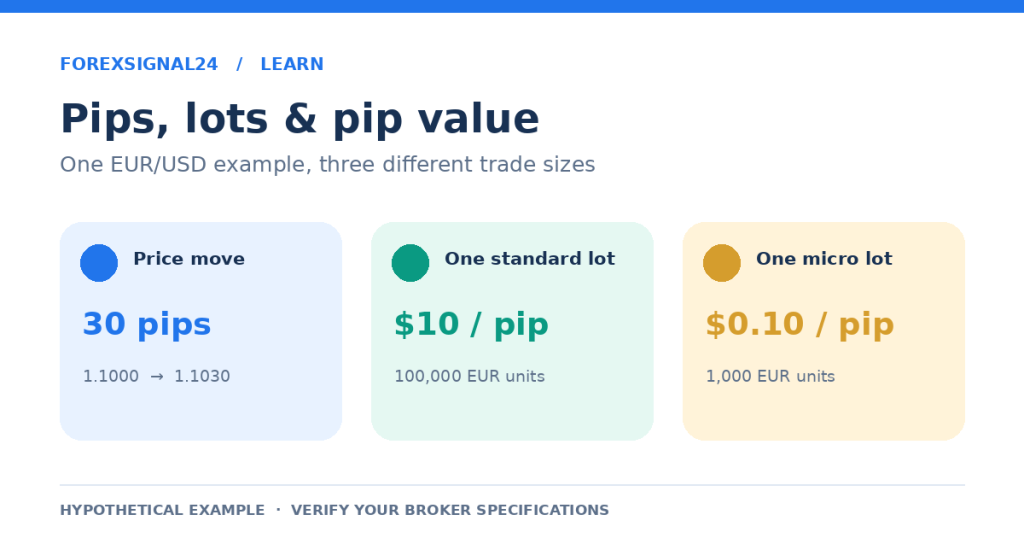
A trader can know that EUR/USD moved 30 pips and still misjudge what that move means in money. The missing piece is position size: the number of currency units represented by the order. This guide connects the quote, the pip and the lot before you move on to position sizing from a stop loss. Every price in the examples below is hypothetical, and none is a current market quote.
Key takeaways
- A pip describes a price change; a lot describes how much of the base currency a position represents.
- For a USD account trading EUR/USD with a 100,000 EUR contract, one 0.0001 pip is $10 per standard lot, $1 per mini lot and $0.10 per micro lot.
- The contract size, price increment and allowed volume step are symbol settings. Check them in your own platform before using any example.
Read the two currencies first
EUR/USD places EUR first (the base currency) and USD second (the quote currency). An illustrative quote of 1.1000 means one euro is priced at 1.1000 US dollars. If the quote rises to 1.1030, it has changed by 0.0030 USD per EUR. A change in price alone does not tell you the trade’s gain or loss: you also need the direction and the number of EUR units held.
Many non-JPY forex pairs conventionally use 0.0001 as a pip. Some platforms display an extra decimal place, where 0.00001 is a smaller quote increment rather than a full pip. JPY pairs often use 0.01 as a pip. Platform “points,” ticks and pips should not be treated as interchangeable without looking at the symbol specification.
A lot is a position size, not a cash deposit
For a familiar EUR/USD example, suppose one lot means 100,000 EUR units. On an MT4 style lot entry, 1.00 lot then means 100,000 EUR, 0.10 lot means 10,000 EUR and 0.01 lot means 1,000 EUR. OANDA documents these standard, mini and micro relationships while also noting that its own unit based platform can accept positions in currency units. This is a useful reminder that the order entry method depends on the platform and account.
| Example volume | Base currency units | Value of a 0.0001 EUR/USD move |
|---|---|---|
| 1.00 lot | 100,000 EUR | $10.00 |
| 0.10 lot | 10,000 EUR | $1.00 |
| 0.01 lot | 1,000 EUR | $0.10 |
This table assumes a 100,000 EUR contract, a USD denominated account and no conversion fee. It is a price sensitivity table, not a promise about what any order will earn or lose after trading costs.
Calculate a pip value step by step
Formula: pip value in the quote currency = lot volume × contract units per lot × pip size. If the quote currency and account currency match, no further currency conversion is needed. For one standard EUR/USD lot in this example, 1 × 100,000 EUR × 0.0001 USD per EUR = $10 for one pip. For 0.01 lot, it is 0.01 × 100,000 × 0.0001 = $0.10 per pip.
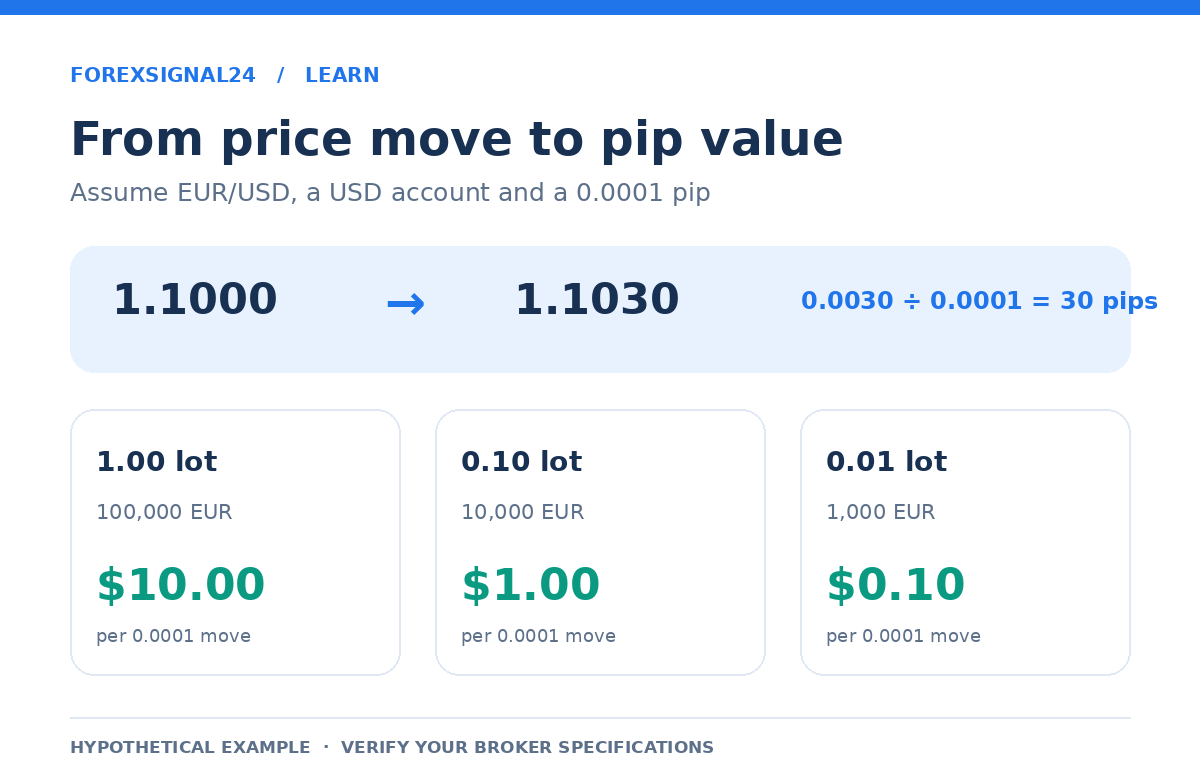
From 1.1000 to 1.1030, the difference is 0.0030. Dividing by 0.0001 gives 30 pips. A 0.01 lot long position would therefore show a $3 price gain before costs (30 × $0.10), while a short position of the same size would show a $3 price loss. Reversing the price move reverses those signs. A position opened at the bid or ask and closed at the other side will also reflect the spread.
What changes when the account or quote currency changes?
The first calculation gives a value in the quote currency. If you trade USD/JPY, for example, the quote currency is JPY, so a USD account needs a JPY to USD conversion at the relevant rate. The conversion rate can change while the position is open. If your account is in EUR but you trade EUR/USD, the USD pip value also needs conversion into EUR. Use the Pip Value Calculator with the conversion input checked against your account and broker; it does not pull a live rate.
Check the symbol before trusting a lot number
In MetaTrader’s Market Watch, open a symbol’s Specification and read the contract size, tick size, tick value, minimum volume and volume step. The broker defines these properties for the symbol. An order for “0.01 lot” means only 1,000 base units if the contract is 100,000 base units per lot. Gold and other CFDs can use a different contract entirely; the XAUUSD lot size guide shows why copying the EUR/USD lot assumption to gold is risky.
Common mistakes and limits
- Treating five displayed decimals as five digit pips, which makes a planned stop ten times too small or large.
- Assuming one lot always has the same contract size across brokers, account types and instruments.
- Quoting a USD pip value for a non USD account without applying an exchange rate.
- Ignoring spread, commission, swaps and execution differences when translating price movement into actual account P&L.
Leverage can make a large notional position accessible with relatively little margin, but it does not make that position small. The CFTC warns that leveraged OTC forex can amplify losses and may expose traders to losses beyond an initial deposit, depending on the account and jurisdiction. Learn the unit math before selecting a volume.
Frequently asked questions
Is a pip the smallest possible price change?
Not necessarily. A broker may quote smaller increments than the conventional pip. Check the symbol’s tick size and the way your platform labels points.
Does 0.01 lot always equal $0.10 per pip?
No. That result describes this EUR/USD example with a 100,000 EUR contract and a USD account. Another pair, account currency or contract size can give a different value.
Continue the series
Use these units to work through a complete position size calculation, then compare the different contract assumptions in the XAUUSD guide. For a calculation using your own inputs, open the Pip Value Calculator.
Sources and further reading
- OANDA: lot sizes and currency units (checked September 24, 2026).
- MetaTrader 5: symbol specification in Market Watch (checked September 24, 2026).
- CFTC: Eight Things You Should Know Before Trading Forex (checked September 24, 2026).