
A 2R target does not make a trade a 2R winner if half the position is closed at 1R. Partial take-profit changes the realized payoff; the maths should be decided before the trade, not reconstructed afterward.
Scaling out can be useful. It can reduce open exposure and make a trade easier to manage. But traders sometimes quote the final chart target as though it applied to their entire position, overstating their reward. The more useful question is: what is the weighted result across every exit?
Start with the original risk unit
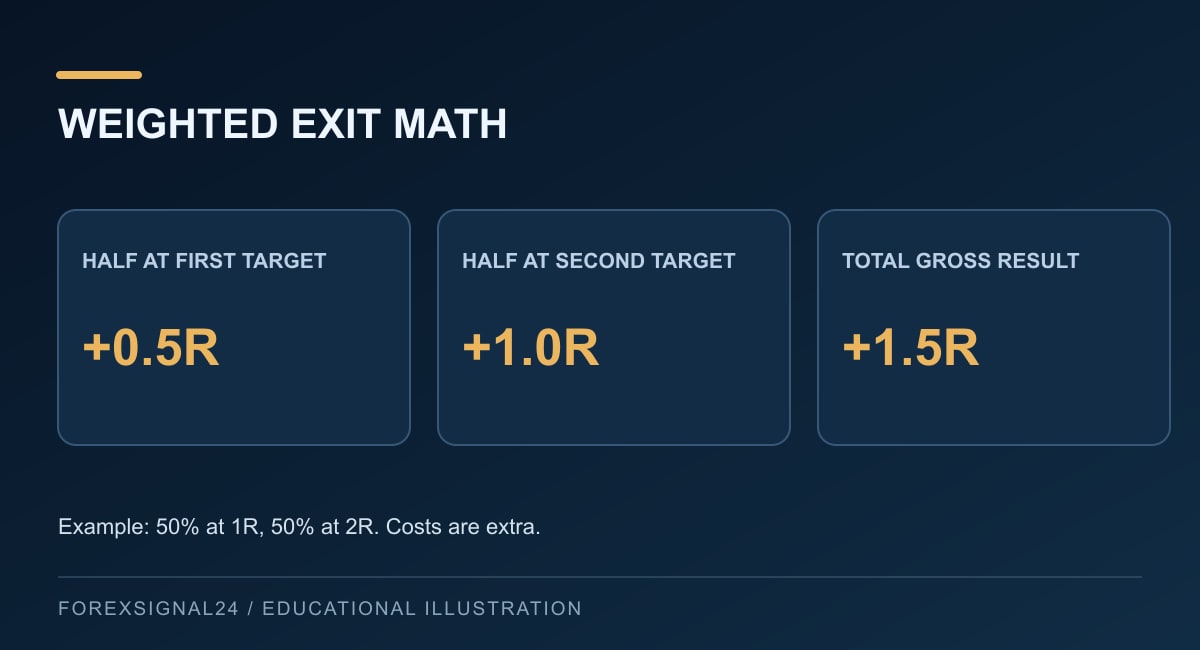
Suppose you enter a forex trade with a 30-pip stop and an initial planned loss of $100, excluding costs. That $100 is 1R. Price advances 30 pips to the first target (1R), where you close half the position. The remaining half is sold at 60 pips (2R). The total reward is not $200.
| Exit | Closed share | Multiple on that share | Contribution |
|---|---|---|---|
| First target | 50% | +1R | +0.5R |
| Second target | 50% | +2R | +1.0R |
| Combined | 100% | — | +1.5R |
On the original $100 risk unit, this is a hypothetical $150 gross win. The general formula is weighted realized R = sum of (closed fraction × R at that exit). The exit fractions must add to 100% of the original position. When pricing is in pips instead of R, convert every exit to the same baseline.
What happens when only the first target is reached?
Assume the first half closes at +1R and the second half eventually stops at the original −1R level. The weighted outcome is +0.5R − 0.5R = 0R before costs. A trade might have reached its first target, yet the overall result is approximately breakeven gross. Commissions, spread and slippage can turn that into a net loss.
Moving the remaining stop to the entry price changes the theoretical scenario: +0.5R from the first exit and approximately 0R from the second. That is +0.5R gross, but an entry-level stop may still incur slippage and there may be additional execution charges. A tighter stop also changes the chance of premature exit; it is not free protection.
Does scaling out improve expectancy?
Not automatically. Partial exits change the distribution of winners, the duration of open risk and transaction costs. Their benefit depends on how frequently the market reaches the first target, how often it continues, and what the remaining position does. Compare consistent exit rules over a meaningful sample rather than selecting only the trades where scaling out looked attractive.
Calculate the original setup with the Risk/Reward Calculator, then record actual weighted R in a journal. The break-even win-rate guide explains why average winning and losing amounts matter more than a headline target.
A four-line trade plan
Before entry, define the stop; the percentage you will close at each target; what happens to the remaining stop after the first exit; and the condition for abandoning the plan. Once the position is open, avoid changing exit rules merely to make an individual trade feel more comfortable. A precommitted plan is easier to audit.
Frequently asked questions
Is closing half at 1R always safer?
It reduces remaining position size, but whether it produces better long-run results depends on the full exit policy and market behaviour.
Should I ignore commission when calculating R?
No. Track gross and net R separately, and include round-trip commissions and other execution costs in the net result.
Examples are simplified and educational, not a recommended trading setup.