
Choosing an Exness account can look simple until you compare what a trade actually costs. Standard and Pro accounts use a commission-free pricing model, while Raw Spread and Zero offer tighter advertised spreads but add a separate commission.
That leads to a more useful question than simply asking which account has the lowest spread: which Exness account produces the lowest effective round-trip trading cost once spread and commission are combined?
To make the comparison practical, we ran several example scenarios through the ForexSignal24 Spread & Commission Calculator. The tool estimates direct entry-and-exit costs by combining spread cost and round-trip commission. It does not include swaps or slippage, so the result should be treated as a cost estimate rather than a live broker quote.

Exness Standard vs Pro vs Raw Spread vs Zero at a glance
Exness currently groups Standard as a standard account and Pro, Raw Spread and Zero as professional accounts. According to the broker’s official account specifications, Standard spreads start from 0.2 pip and Pro spreads from 0.1 pip, with no separate trading commission on either account. Raw Spread starts from 0.0 pip and charges up to $3.50 per lot per side, while Zero also starts from 0.0 pip and uses an instrument-dependent commission that starts from $0.05 per lot per side.
| Exness account | Published spread | Trading commission | Pricing structure |
|---|---|---|---|
| Standard | From 0.2 pip | None | Spread only |
| Pro | From 0.1 pip | None | Lower spread, no commission |
| Raw Spread | From 0.0 pip | Up to $3.50/lot/side | Raw spread + commission |
| Zero | From 0.0 pip | Instrument dependent | Zero/very low spread + commission |
There is one important detail behind those numbers: “from” is not the same as a live average spread. Spreads can change with liquidity, volatility, trading sessions and market conditions. Exness also notes that trading-cost estimates depend on current specifications and market conditions. That is why the examples below separate published minimum figures from hypothetical live-spread scenarios.
Official references: Exness trading account types, Raw Spread account and Zero account.
How the ForexSignal24 trading-cost calculation works
The calculator uses a deliberately transparent method. Spread cost is calculated from the spread in pips and the pip value of the position. The round-trip commission is then added to the spread cost.
Spread cost = spread in pips × pip value
Total estimated trading cost = spread cost + round-trip commission
For EUR/USD, one standard lot represents 100,000 units. With a USD-denominated account, the pip value for 1.00 lot is approximately $10 per pip. A 0.5-pip spread therefore represents about $5 in spread cost. If the same account charges a $7 round-trip commission, the estimated direct trading cost becomes $12.
The ForexSignal24 calculator excludes swaps and slippage. That makes it particularly useful for comparing account structures where the main difference is how much cost sits in the spread and how much is charged separately as commission.
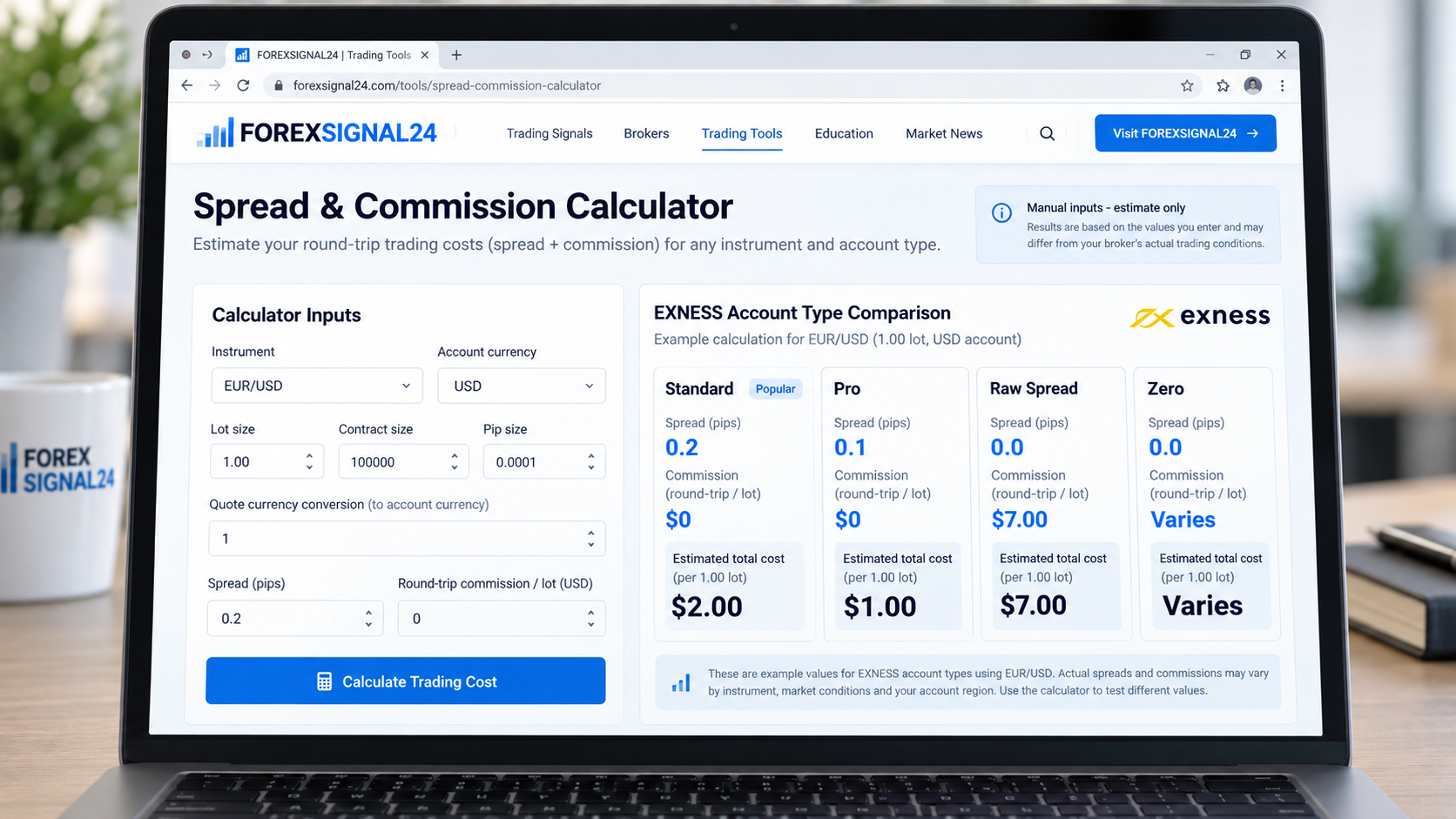
Test 1: Exness Standard
Standard is the simplest account in this comparison. Exness lists spreads from 0.2 pip and no separate trading commission. Orders use market execution, and the account supports a broad range of forex and CFD instruments.
For an illustrative 1-lot EUR/USD calculation, we can use a 0.2-pip spread and zero commission. With a pip value of about $10, the published-minimum example produces an estimated spread cost of $2 and a total estimated direct cost of $2.
That does not mean every 1-lot EUR/USD trade on Standard costs $2. If the live spread at the time of the trade were 0.8 pip, for example, the same calculation would become approximately $8. The live spread is therefore the variable that matters most for a commission-free account.
Test 2: Exness Pro
Pro is particularly interesting because it combines lower published spreads with no separate commission. Exness currently lists the account with spreads from 0.1 pip, while execution can be instant or market execution depending on the instrument and account setup.
Using the same 1-lot EUR/USD example and the published minimum spread of 0.1 pip, the estimated spread cost would be about $1. With no commission added, the estimated total remains $1.
On published minimum figures alone, that can make Pro look cheaper than a Raw Spread account that advertises 0.0 pip but adds a commission. The comparison becomes more meaningful, however, when we replace minimum figures with realistic live-spread assumptions.
Test 3: Exness Raw Spread
Raw Spread uses the opposite pricing structure. Exness advertises spreads from 0.0 pip and charges a fixed commission of up to $3.50 per lot per side on most instruments. A commission quoted “per side” needs to be converted into a round-trip figure before entering it into the ForexSignal24 calculator.
At $3.50 per side, the opening commission is $3.50 and the closing commission is another $3.50, giving a maximum illustrative round-trip commission of $7 per lot.
If EUR/USD were available at a 0.0-pip spread, spread cost would be $0 and the estimated total would be $7. If the spread were 0.1 pip instead, spread cost would be about $1 and the estimated total would rise to about $8.
This is why “raw spread” should not be read as “free trading.” A near-zero spread can be useful, especially for strategies that are sensitive to the bid-ask spread, but commission remains part of the transaction cost.
Test 4: Exness Zero
Zero works differently again. Exness states that the account can offer zero spread on its top 30 traded instruments for 95% of the trading day, depending on market volatility. The commission is instrument-specific and starts from $0.05 per lot per side.
That instrument-specific commission is important. It would be misleading to take the lowest advertised commission and assume that it applies to EUR/USD, XAU/USD or every other instrument. Traders should check the current contract specification for the exact symbol they plan to trade.
If your platform shows a commission of X dollars per lot per side, the value entered into the ForexSignal24 calculator should be 2 × X as the round-trip commission. This is exactly why the calculator uses manual inputs instead of pretending to provide live broker pricing.
A more realistic EUR/USD comparison
Published minimum spreads help explain how each account is structured, but they are not enough to decide which account is cheaper in practice. The following example uses hypothetical spreads for a 1-lot EUR/USD round trip. These are not live Exness quotes; they are simply a scenario for showing how the calculation changes.
| Account | Example spread | Spread cost | Example RT commission | Estimated total |
|---|---|---|---|---|
| Standard | 0.8 pip | $8 | $0 | $8 |
| Pro | 0.5 pip | $5 | $0 | $5 |
| Raw Spread | 0.1 pip | $1 | $7 | $8 |
| Zero | 0.0 pip | $0 | Instrument-specific | Depends on commission |
This example makes the central point clear: the account with the lowest spread is not automatically the account with the lowest total trading cost. In this scenario, Pro would produce a lower estimated direct cost than Standard and Raw Spread, while Zero cannot be compared fairly until the instrument-specific commission is entered.
Change the spread assumptions or the applicable commission, however, and the result changes. That is why it is better to calculate the trade you actually plan to place rather than rely on a marketing headline.
What happens at 0.10, 0.50 and 1.00 lot?
Trading cost scales with position size. Using the same hypothetical spreads above, the effect becomes easy to see.
| Account scenario | 0.10 lot | 0.50 lot | 1.00 lot |
|---|---|---|---|
| Standard at 0.8 pip | $0.80 | $4.00 | $8.00 |
| Pro at 0.5 pip | $0.50 | $2.50 | $5.00 |
| Raw at 0.1 pip + $7/lot RT | $0.80 | $4.00 | $8.00 |
A difference of a few dollars on a single transaction may look small. For an active trader, frequency changes the picture. A $3 difference per 1-lot round trip becomes $30 over 10 trades, $150 over 50 trades and $300 over 100 trades.
This is one reason spread and commission deserve more attention from scalpers and active intraday traders than from traders who only open a few positions each month.
Which Exness account has the lowest trading cost?
There is no single account that can honestly be labelled the cheapest under every market condition. Standard has the simplest structure because there is no separate commission, but the live spread carries most of the direct transaction cost. Pro also has no trading commission and starts from a lower published spread, which can make its effective cost competitive when live spreads remain tight.
Raw Spread moves more of the cost into a separate commission. The tighter spread can be attractive, but the commission must always be added before comparing it with Standard or Pro. Zero can be especially interesting when an eligible instrument is trading at zero spread, but the final result still depends on the commission for that specific instrument.
Instead of asking only, “Which account has the lowest spread?”, the more useful question is: “What is the total spread plus commission cost for the instrument, trade size and market conditions I actually trade?”
How to test your own Exness account
You do not need to rely on the examples in this article. Open your Exness platform or contract specifications and note the current values for the instrument you trade. Then open the ForexSignal24 Spread & Commission Calculator.
- Select or enter the instrument details.
- Set your account currency and lot size.
- Check the contract size and pip size.
- Enter the spread you want to test.
- Enter the full round-trip commission per lot.
- Run the same scenario for Standard, Pro, Raw Spread and Zero.
If the broker quotes commission per side, double it before entering the value. The calculator expects the complete round-trip commission per lot.
Run your own Exness cost comparison
Use your current spread and commission figures instead of relying on advertised minimums.
Final takeaway
The main lesson from comparing Exness Standard, Pro, Raw Spread and Zero is that spread alone tells only part of the story. Standard may have a wider spread but no commission. Raw Spread may show almost no spread while charging a fixed commission. Zero may remove most of the visible spread on certain instruments but still charge an instrument-specific commission. Pro sits between those models, combining tighter published spreads with commission-free pricing.
Converting each structure into one figure—estimated round-trip trading cost—makes the comparison much easier to understand. More importantly, it lets traders test the numbers that matter to their own strategy rather than relying on a broker’s minimum “from” figure.
Disclaimer: This article is for educational comparison only. Published minimum spreads are not guaranteed live spreads. Actual spreads, commissions, execution prices and other trading costs can vary by instrument, account, entity and market conditions. The ForexSignal24 calculator excludes swaps and slippage and does not provide trading advice.